Introduction
The first time I saw a Monet water lily painting in person, I stood in front of it for so long that a museum guard asked if I was feeling unwell.
I was fine. I was just transfixed. The surface of the water seemed to shimmer and shift as I moved, the lily pads floating in layers of green and violet, the sky and willow branches reflected in dappled strokes of color that did not quite touch but somehow created the most perfect illusion of a summer afternoon on a pond.
I walked away from that gallery thinking, "I will never be able to paint like that." And technically, I was right.
Monet spent thirty years refining his water lily paintings, producing more than two hundred and fifty works in the final decades of his life.
He built a garden specifically to paint it. He knew every angle of light across that pond, every color the water turned in rain and sun and mist.
But here is what I have learned in the years since: you do not need to paint like Monet to capture the feeling of a Monet painting.
The techniques he used — the broken color, the attention to reflections, the willingness to let brushwork speak for itself — are surprisingly accessible.
And when you apply them to your own water scene, whether it is a backyard koi pond, a local lake, or a photograph from a summer vacation, the results can be genuinely stunning.
The first time I tried, I painted a small study of a lily pond near my grandmother's house.
It was not a Monet. But when I stepped back, the water actually looked wet.
The light actually looked real. And that was enough to make me want to paint another.
Understanding What Made Monet's Water Scenes So Magical
Before we pick up a brush, it helps to understand what Monet was doing differently.
His water lily paintings are not realistic in the photographic sense. They are records of light and atmosphere.
Monet was less interested in painting a lily pad than in painting the way light fell on that lily pad at a specific moment on a specific day.
He used several key techniques that any beginner can learn:
- Broken color: Instead of mixing a flat green for a leaf, he placed small strokes of different greens, yellows, and blues next to each other. The eye blends them from a distance, creating a vibrant, shimmering effect.
- Reflections as subject: In many of his paintings, the reflections on the water are more detailed and colorful than the objects being reflected. The sky, the trees, the clouds — they all live on the surface of the pond.
- Eliminating the horizon: In his later works, Monet removed the shoreline entirely. The entire canvas is water, lilies, and reflections. This creates an immersive, almost meditative experience for the viewer.
- Atmospheric color: Shadows in his paintings are rarely gray or black. They are deep purples, blues, and greens. Sunlit areas are warm yellows and pinks, even in unexpected places.
These techniques are not exclusive to master painters. They are choices — decisions about what to emphasize and what to simplify. And you can start making those choices today.
What You Will Need for Your Water Scene Painting
The beauty of painting water scenes is that you do not need specialized equipment. The same supplies you would use for any landscape painting will work beautifully. Here is what I recommend for a beginner tackling their first lily pond or water scene.
Paint Colors for Water Scenes
A limited palette is ideal. You will be doing a lot of mixing anyway, and a small selection of colors will force you to observe the true hues in your reference rather than reaching for a premade green. I suggest:
- Titanium white (you will use more of this than you expect for reflections)
- Cadmium yellow light (for sunlit highlights and warm reflections)
- Ultramarine blue (the foundation of deep water and shadows)
- Cerulean blue or cobalt blue (for clear, bright water)
- Alizarin crimson (for the purples and pinks in reflected light)
- Sap green or viridian (for lily pads and vegetation)
- Yellow ochre (for warm earth tones and softening greens)
If you are working in acrylics, a stay-wet palette will keep your paints workable longer. For oils, a traditional wooden palette is fine. For watercolor, a simple folding palette with wells works beautifully.
Surfaces and Brushes
A medium-tooth canvas or canvas panel, nine by twelve inches or eleven by fourteen, gives you enough room to work without feeling overwhelmed by empty space. If you are a watercolor painter, use cold-press paper taped to a board.
For brushes, reach for a variety pack that includes:
- A flat brush, half-inch or one-inch, for blocking in large areas of water and sky
- A round brush, size six or eight, for lily pads and flower shapes
- A filbert brush for blending soft reflections
- A small liner or rigger brush for fine stems and details
Finding Your Reference: The Perfect Water Scene
You do not need a French water garden to paint a beautiful water scene. A photograph from a local park pond, a friend's backyard koi pool, or even a still from a nature documentary can serve as your starting point.
The key is to choose a reference with clear light and shadow, visible reflections, and some vegetation on or near the water.
If you want to work from imagination or memory, that is also valid. Monet himself painted many of his later water lilies from memory, working in his studio with nothing but his accumulated observations of the pond.
A simple image in your mind — a cluster of lily pads, a reflection of clouds on still water, a few reeds at the edge — is enough to begin.
The Step-by-Step Method for Painting Water and Reflections
This method works for acrylic, oil, or watercolor painters. Adjust the drying times according to your medium.
Step One: Prepare Your Surface and Sketch the Composition
If you are using acrylics or oils, apply a thin wash of diluted ultramarine blue or a warm neutral gray over your entire canvas. This kills the white and gives you a middle tone to work against. Let it dry completely.
With a soft pencil or a thin brush loaded with diluted paint, lightly sketch the major elements of your composition.
Where are the largest lily pads? Where is the main reflection? Where does the shoreline or vegetation sit?
Keep the sketch loose — you are mapping territory, not drawing a blueprint.
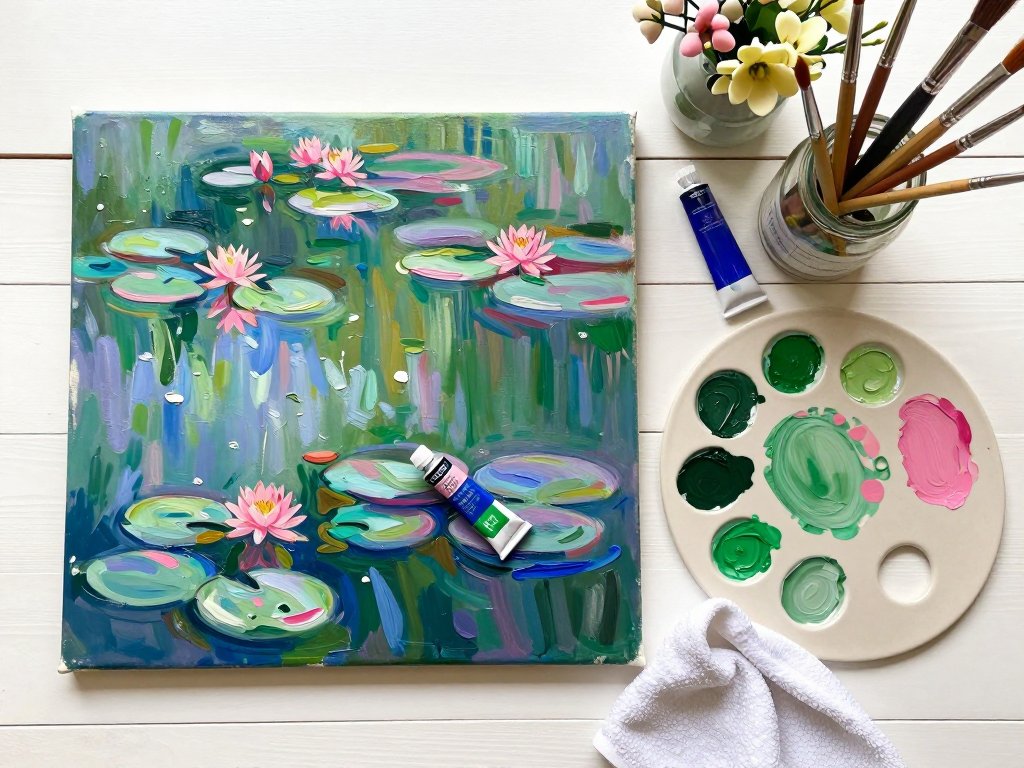
For a classic Monet-inspired composition, place the horizon line very high on the canvas or eliminate it entirely. Let water and reflections fill most of the frame. Place your largest lily pads in the lower third of the canvas, clustered slightly off-center, with smaller pads receding toward the middle distance.
Step Two: Block in the Water and Reflections
This is the most important step, and it is the one most beginners rush. Take your time here.
Mix three to four values of your water color: a deep value for the darkest water (ultramarine blue with a touch of alizarin crimson), a mid-value for the general water surface (cerulean or cobalt blue with white), and a light value for reflections (the same mid-value with added white and a tiny touch of yellow).
Using a flat brush, lay down the water in broad horizontal strokes. Do not paint every inch of the canvas yet.
Leave areas where reflections will go. Apply the reflection colors in vertical or slightly diagonal strokes that follow the direction of the reflection.
This contrast between horizontal water strokes and vertical reflection strokes is one of the oldest tricks in painting — it immediately reads as reflective water.
Remember that reflections are rarely the same color as the object being reflected. They are darker, softer, and often tinted by the color of the water.
A bright green tree on the shore might reflect as a muted blue-green on the water's surface.
A white cloud might reflect as a soft yellow-white if the water is carrying a sandy bottom or algae.
Step Three: Add the Lily Pads
Mix two to three greens for your lily pads. A warm green (sap green with yellow ochre) for sunlit pads, a cool green (viridian with a touch of ultramarine) for shaded pads, and a light green (warm green plus white) for the highlights on the edges of the pads.
Using a round brush, paint the lily pads as loose oval or kidney shapes. They do not need to be perfect.
In fact, imperfect edges look more natural. Leave small gaps between pads — water should show through.
Add a highlight stroke along the edge of each pad where the light catches it.
This small detail is what makes the pads feel like they are resting on the water rather than floating above it.
Vary the sizes of your pads. Large pads in the foreground, medium pads in the mid-ground, tiny dots in the distance. This creates depth without any complex perspective drawing.
Step Four: Paint the Lily Flowers
Lily flowers can be as simple or as detailed as you like. For a quick study, paint them as small clusters of white and pink strokes. For a more developed painting, build each flower with three to four values.
Mix a warm white (white plus a touch of cadmium yellow) for the lightest petals, a cool white (white plus a touch of cerulean) for shaded petals, and a pink (white plus alizarin crimson) for the flower centers and any pink blooms.
Using a small round brush, paint the petals as loose, overlapping strokes radiating from the center of the flower. Do not outline each petal. Let the strokes overlap and blend naturally. Add a tiny dot of pure cadmium yellow at the center for the stamens.
Space your flowers across the lily pad cluster. Too many flowers clustered together looks unnatural. One or two fully open blooms, a few buds, and the rest as simple suggestion strokes creates a more convincing scene.
Step Five: Refine Reflections and Add Atmosphere
Step back from your painting. Look at where the reflections are strongest and where they are most subtle.
Strengthen the contrast in your focal area — typically near the center or where the largest lily pads sit.
Soften the edges of your reflections by lightly brushing over them with a clean, dry filbert brush.
Add a few horizontal ripples across the water surface. These are simply thin, horizontal strokes of pure white or light blue applied with the edge of a flat brush. Space them irregularly. They suggest a gentle breeze and give the water surface texture.
If you want to capture the atmospheric quality of Monet's work, mix a very thin glaze of color (a pale lavender or warm peach) and apply it lightly over your drying painting.
This unifies the colors and gives the scene a specific time-of-day feeling. Monet often painted the same pond at dawn, midday, and dusk, letting the atmospheric color transform the scene completely.
Common Water Painting Mistakes (And How to Avoid Them)
I have made every mistake in this list, sometimes more than once. Here is how to avoid the most frustrating ones.
Water That Looks Like Solid Blue Plastic
This is the most common beginner problem. Water is not solid blue. It is transparent, reflective, and full of color variation.
To fix this, introduce more color variety into your water. Add touches of green near vegetation, warm tones where the bottom is visible, and purple or gray in shadowed areas.
Break up large flat areas of blue with horizontal stroke variations.
Reflections That Look Pasted On
Reflections should feel like they belong to the water, not like they were cut out and glued on top.
The key is softening the edges. After you paint a reflection, go over its bottom edge with a clean, dry brush to blur the boundary between reflection and water.
Also make sure your reflection colors are slightly less saturated than the object being reflected — reflections naturally lose some color intensity.
Lily Pads That Float Above the Water
A lily pad that is painted with a hard outline around its entire edge will look like it is hovering above the surface.
To fix this, let the bottom edge of each pad blend slightly into the water color below it.
Add a small shadow underneath the pad using a very thin mix of ultramarine blue and alizarin crimson.
And paint the water OVER the edge of the pad in one or two spots — this creates the illusion that the pad is nestled into the water rather than resting on top of it.
Overworking the Surface
Water scenes are particularly vulnerable to overworking because there is so much surface area to cover.
Set a timer for your painting session. When it goes off, step back and assess.
If the water reads as wet and the reflections read as reflective, you are done.
Adding more strokes will only muddy the effect. Know when to stop — your painting will thank you.
Building a Series: The Magic of Painting the Same Scene in Different Light
One of the most rewarding things you can do as a painter is what Monet did so masterfully: paint the same water scene at different times of day, in different weather, across different seasons.
You do not need a lily pond for this. A simple park pond, a neighborhood creek, or even a rain puddle that reflects the sky can become a series.
Take a photograph of your chosen spot. Paint it in the bright light of midday.
Then go back at golden hour and paint the same view again. Paint it on an overcast day when the water turns silver-gray.
Paint it after a rain when every leaf is dripping. Each painting will teach you something new about color, light, and atmosphere.
And over time, you will build a collection that tells the story of a place across an entire season.
I did this with a small pond near my home in upstate New York. By the end of the summer, I had sixteen small studies — dawn, midday, dusk, cloudy, rainy, golden.
They are not Monet water lilies. But together, they capture something true about that particular pond in that particular year.
And when I look at them hung together on my studio wall, I feel exactly what I felt standing in front of those Monets at the museum: the quiet thrill of seeing light captured in paint.
Conclusion
Painting water scenes is one of the most rewarding challenges a beginner can take on.
The subject is endlessly forgiving — water moves, changes, reflects, and never looks the same twice.
Every mistake can be repurposed. A patch of color that did not quite work as a lily pad might become a perfect reflection.
A brushstroke that went too wide might become the glint of light on a ripple.
Start with a simple composition: a cluster of lily pads, a reflection of the sky, a few soft ripples.
Use broken color. Keep your brushwork visible. Let the water be mysterious and full of unexpected hues.
And remember that you are not trying to replicate a photograph. You are trying to capture a feeling — the way light feels on a summer afternoon, the way water sounds when it laps gently against lily pads, the way a pond holds the sky in its surface like a treasure.
Monet spent thirty years painting water lilies because he knew he would never exhaust the subject.
You will not either. But your first painting will be a beginning — and every painting after it will bring you closer to the water, the light, and the quiet joy of watching a pond come alive on your canvas.