Introduction
Do you remember the last time you doodled without thinking? Maybe it was on the corner of a to-do list while you waited on hold, or in the margin of a notebook during a long meeting.
Your pen wandered, made little loops and stars, and for a few moments your mind went quiet.
That quiet feeling — that is what doodle art is really about.
Doodle art is creative sketching with no pressure attached. There is no wrong way to do it, no final product you have to live up to, and no expensive supplies to buy.
All you need is a pen and a piece of paper. It is the perfect craft for a stay-at-home mom who has ten minutes between school pickup and dinner, or who wants something soothing to do after the children are finally asleep.
In this guide, we will explore why doodling relaxes us, how to begin with simple marks and patterns, and how to turn your wandering lines into little works of art you will actually love.
You do not need to be an artist. You only need to be willing to let your pen play.
Why Doodling Feels So Good
There is real science behind the calm that settles over you when you doodle. When your hand makes small, repetitive movements, your body begins to settle.
Your breathing slows. The chatter in your head — the grocery list, the school emails, the worry about tomorrow — fades into the background while your attention rests on the simple motion of pen meeting paper.
Art therapists have used repetitive drawing for years to help people manage stress and anxiety.
The rhythm of the marks, the gentle focus on one small area at a time, and the absence of any judgment all work together to quiet the mind.
It is a little like meditation, but friendlier — you do not need to empty your thoughts, only to follow your pen.
Doodling also gives you a small, reliable sense of accomplishment. Each finished corner of a pattern is a tiny win.
On days when the house feels chaotic and nothing seems to go as planned, that quiet line of tidy spirals you just drew is proof that you can still make something orderly and beautiful.
What You Need to Start (Very Little)
Here is the best part about doodle art: you already own everything you need. A ballpoint pen and any scrap of paper will do.
There is no need to wait for supplies to arrive or to clear a dedicated craft space.
You can doodle at the kitchen table, on the couch, or sitting on the floor of the playroom while the children build with blocks.
That said, if you want to treat yourself, a few simple upgrades make the experience even nicer.
A fine-tipped black pen, like a fineliner in 0.3 or 0.5 millimeters, gives you crisp, clean lines.
A small sketchbook with smooth paper is lovely to hold and gives your doodles a home.
Some people enjoy colored pens or a set of gel pens for adding accents. But none of these are required — please do not let a shopping list become a reason to wait.
A pen from the junk drawer is a perfectly good beginning.
One tip from my own experience: keep a small notebook and a pen in a spot you pass every day — by the kettle, on the nightstand, or in your bag.
When the mood strikes, it is right there. You would be surprised how often a spare five minutes appears when your supplies are within reach.
Getting Started: Just Make Marks
The first step is the easiest and the hardest: put pen to paper and make a mark. Do not try to draw anything recognizable. Do not plan. Simply make a dot, a line, a squiggle, and see where your hand wants to go next.
Here is a gentle exercise to loosen you up. Draw a small circle in the middle of your page.
Then, without overthinking, fill the space around it with whatever your pen feels like making — tiny dashes, little waves, crossing lines, scattered dots.
There are no rules. If you feel stuck, repeat the same mark a few times; repetition is its own comfort.
Notice how your body feels while you do this. Notice the small shift as your shoulders drop and your attention narrows. That shift is the whole point. You are not making art to show anyone; you are making marks to be kind to yourself.
Five Simple Patterns to Practice
Once your hand is warmed up, patterns are wonderful building blocks. They are easy to learn, satisfying to repeat, and they combine into beautiful larger designs. Here are five beginner-friendly patterns to try.
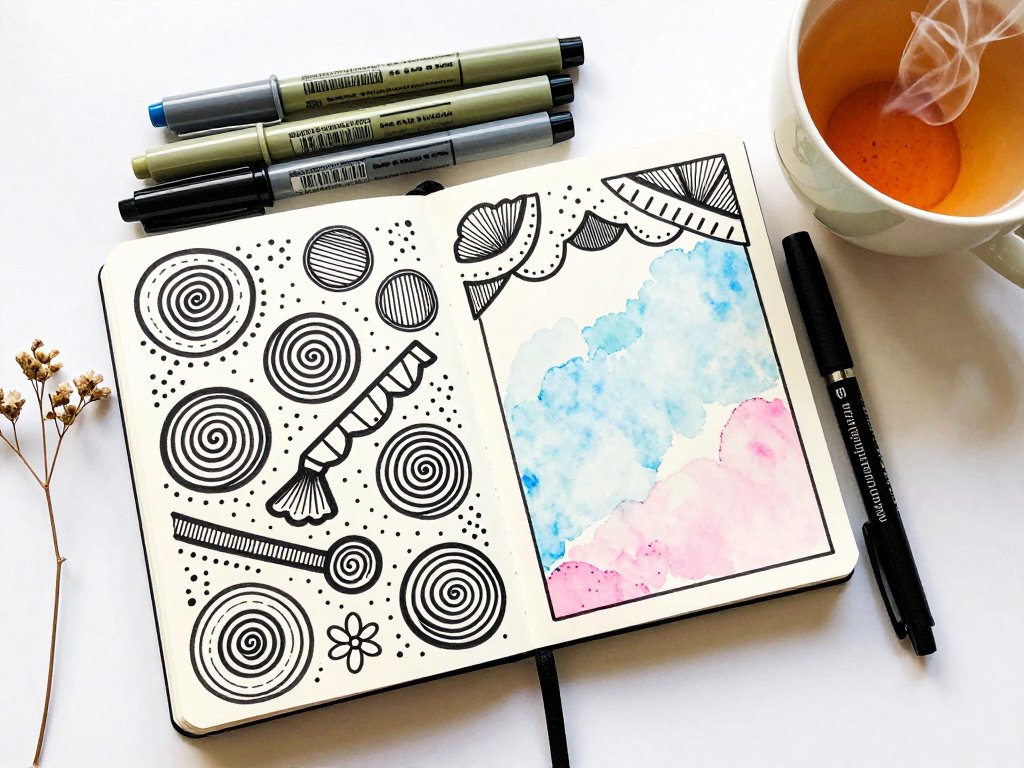
Spirals. Start at the center and draw a slow, continuous spiral outward. Keep the spaces between the lines even, but do not stress if they wobble — a slightly uneven spiral has its own charm. Fill a whole page with spirals of different sizes for a lovely, calming study.
Scallops and waves. Draw a row of overlapping half-circles, like fish scales or waves. This pattern feels wonderfully rhythmic once you find your groove. Try filling a shape with rows of scallops, letting each row nestle into the one above it.
Zigzags and chevrons. Simple zigzag lines, stacked in layers, make a striking geometric pattern. Draw one zigzag across the page, then another slightly below it, and connect the peaks and valleys for a chevron effect.
This is a great pattern for when your mind is racing — the straight lines give it something steady to hold onto.
Dots and dashes. A pattern of dots and dashes in little clusters adds lovely texture. Group three dots, then a dash, then repeat. Vary the spacing. This pattern is almost meditative in its simplicity and looks surprisingly polished when it fills a section.
Petals and leaves. Draw a small circle and surround it with simple petal shapes, like a flower seen from above. Add a second ring of petals behind the first. This pattern grows beautifully and can become a whole garden across your page.
Practice one pattern at a time, and give yourself permission to fill several pages with the same pattern. Repetition is how your hand learns, and there is real pleasure in watching a skill smooth out with practice.
Doodles with Meaning: Tiny Scenes and Stories
Once patterns feel comfortable, you might enjoy doodles that tell a tiny story. These are still simple, but they carry a little more heart.
My favorite kind of doodle is the one that captures a small moment — a cup of tea with steam curling up, a cat asleep in a sunbeam, a row of houses with their windows glowing.
Try making a doodle diary for a week. Each evening, spend five minutes drawing something from your day.
It does not need to be realistic — a simple shape that reminds you of the moment is enough.
The school run becomes a little car with two circles for wheels. The rain outside becomes a window with diagonal lines and a tiny umbrella.
Over time, this little diary becomes a treasure, a record of ordinary days made special by your attention.
Doodles with meaning are also lovely gifts. A small card decorated with a doodle of the recipient's favorite flower, or a bookmark with a pattern in their favorite colors, says more than a store-bought card ever could. Because it is handmade, it carries the warmth of your time and care.
Zentangle-Style Filling: One Shape at a Time
You may have seen the intricate, jewel-like drawings of the zentangle method and assumed they were beyond you. They are not. Those elaborate pieces are built from exactly the kind of simple patterns we have been practicing, filled in one small section at a time.
Here is how to try it the gentle way. Draw a simple outline — a leaf, a heart, a fish, or even just a large circle.
Divide the inside into a few smaller sections with light pencil lines. Then fill each section with a different pattern: spirals in one, dots and dashes in another, scallops in a third.
There is no need to plan the whole piece. You only ever need to decide what the next small section will hold.
This one-shape-at-a-time approach is deeply calming because it shrinks the project down to a single manageable decision.
You are never facing a blank page and a big idea; you are simply choosing the next tiny pattern.
Before you know it, an hour has passed and you have created something intricate and genuinely beautiful.
Coloring and Embellishing Your Doodles
Once you have a doodle you love, adding color brings it to life. You can color in the spaces between patterns, add a wash of watercolor over the whole page, or simply dot a few accents with a colored pen.
There is no wrong way to embellish; let the doodle tell you what it wants.
Watercolor is a particularly forgiving partner for doodles. Because watercolor is translucent, the ink lines show through beautifully, and the paint can wander a little outside the lines without ruining anything. A light wash of color behind a black ink doodle looks like a little piece of illustrated stationery.
Colored pencils are another easy option. They are portable, quiet, and easy to control. Try shading just one element of your doodle — the inside of one spiral, one petal of a flower — and leaving the rest black and white.
That single pop of color draws the eye and makes the piece feel intentional and modern.
Making Doodling a Habit (That Sticks)
The hardest part of any creative practice is not the skill — it is showing up. Here are the small tricks that actually work for busy moms, tested in the real world of laundry baskets and school runs.
Attach it to something you already do. Doodle while your coffee brews, while you wait for pasta water to boil, or for ten minutes after the children are in bed.
Tucking the habit next to an existing routine means you never have to find extra time — it is already there.
Keep the bar absurdly low. Tell yourself you only have to make one mark. One spiral. One row of scallops. On the days when you are exhausted, that single mark is enough to keep the thread alive, and more often than not your hand will want to continue.
Keep your doodles visible. A notebook that lives on the kitchen counter gets doodled in. A notebook that lives in a drawer gets forgotten. Leave your supplies where you will see them, and you will naturally reach for them.
Do not judge your output. Some pages will feel clumsy. Some will be lovely. Both kinds count. The value of doodle art is in the doing, not in the keeping, and every page is practice for the next.
Sharing and Displaying Your Doodle Art
When you have a few doodles you are proud of, it is lovely to share them. You do not need a gallery — your home and your people are the perfect audience.
Frame a favorite doodle in a simple frame and hang it where you will see it daily.
A small black-and-white pattern piece looks surprisingly sophisticated on a hallway wall or above a desk.
Doodles also make charming cards, gift tags, and bookmarks, and they photograph beautifully for a personal Instagram feed if you enjoy sharing your creative life.
If you have children, doodling together is a wonderful way to connect. Hand them a piece of paper and a pen, and let them make marks beside you.
There is something special about sharing a quiet creative moment with a child — no instructions, no expectations, just two people making lines together.
You might even notice that watching you enjoy the process teaches them more about creativity than any lesson could.
Troubleshooting: When Doodling Feels Stuck
Every now and then, even the most willing pen hits a blank. Here is what helps when doodling stops feeling easy.
The page feels blank and intimidating. Start anywhere — literally anywhere — with the smallest mark you can make. A single dot breaks the spell of the blank page. Then make another dot next to it, and another, and let a pattern emerge from those humble beginnings.
You feel like nothing looks good. Remember that doodling is practice, not performance. Look back at pages you made a week ago; they will look better to you now than they did then. That is the quiet progress you cannot see while you are making it.
You run out of ideas. Keep a small list of doodle prompts in the back of your notebook: your favorite mug, the view from your kitchen window, a pattern inspired by your shower curtain, the first thing you saw this morning.
When ideas run dry, the list is there to catch you.
Your hand cramps. Loosen your grip and slow down. Doodling should feel like a gentle glide, not a tight grip. Shake out your hand between pages, and try drawing larger marks with your whole arm instead of just your wrist.
Conclusion: Let Your Pen Wander
Doodle art asks nothing of you except a few minutes and a willingness to play.
It does not care if your lines are straight or your spirals are even. It only asks you to show up, make a mark, and let the rhythm of your pen carry you to a quieter place.
Start tonight, if you like. Find any pen, any piece of paper, and make one small spiral in the corner.
That is enough — truly, it is. And when you are ready for more, come back to this page and try a new pattern, or fill a leaf with tiny scallops, or start a doodle diary of your week.
The best part of this craft is that it grows with you. What begins as a way to pass ten quiet minutes becomes a practice that steadies you on hard days, a record of your small moments, and a gentle reminder that you are allowed to make things simply because they make you happy.
So go on — let your pen wander. You might be surprised where it takes you.