Introduction
Do you remember the last time you sat still with nothing in your hands? For most of us, the answer is a quiet no.
Between school runs, laundry, and the endless to-do list, our hands are always doing something — scrolling, wiping counters, stirring dinner.
That is exactly why I love continuous line drawing. It asks you to do one thing, slowly, with a pen on paper, and it gives your brain a rare kind of rest.
Continuous line drawing is simple: you draw a subject without lifting your pen from the paper.
One unbroken line from start to finish. That is the whole rule, and it is the whole gift.
There is no erasing, no perfectionism, and no way to do it wrong. In this guide, I will show you how to start, what to draw, and how to turn five quiet minutes into a habit that makes you feel like an artist again.
What Is Continuous Line Drawing?
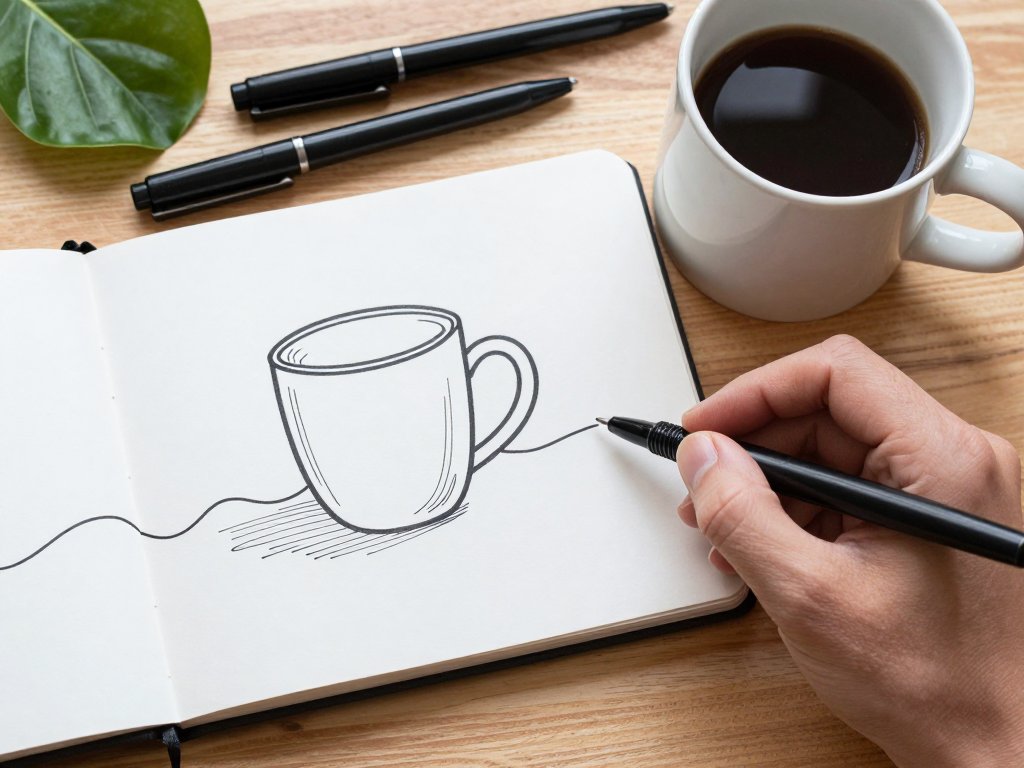
Imagine tracing the outline of a coffee mug with your finger, never lifting it. Now do the same with a pen on paper, and let your eyes follow the mug's edges — the curve of the handle, the rim, the shadow underneath.
The result is a sketch made of a single, flowing line. It might look a little wobbly.
It will definitely look expressive. And it will be completely, unmistakably yours.
Artists have practiced this way for centuries. It is a warm-up exercise in art schools around the world, and it appears in the sketchbooks of some of the most famous painters in history.
The reason is simple: when your pen cannot leave the paper, your hand and eye are forced to work together, and your brain lets go of the need to make everything perfect.
There is also something quietly wonderful about the finished drawings. A continuous line portrait has a loose, alive quality that careful drawings sometimes lose.
The wobbles become character. The overlaps become depth. People look at them and say, "I could never do that" — and then they try, and they can.
Why It's Perfect for a Busy Life
This practice was made for people with fifteen spare minutes and a thousand things to do. Here is why it fits so gently into a full day:
- It takes five minutes. You do not need an hour or a studio. One coffee mug, one teapot, one sleeping cat, and you are done.
- It needs almost nothing. A ballpoint pen and any scrap of paper will do. No special supplies to buy, no setup, no cleanup.
- It cannot fail. Because there is no erasing, there is no "wrong." Every line is a record of looking, and looking is always worthwhile.
- It calms the mind. The slow, unbroken motion is surprisingly soothing — closer to breathing exercises than to homework.
- It builds real skill. Every session quietly improves your hand-eye coordination, your observation, and your confidence with a pen.
That combination is rare. Most crafts ask for time, supplies, and a clean space. Continuous line drawing asks only for a moment of stillness, and it gives back more than it takes.
Supplies: Just a Pen and Paper
Let us talk about supplies honestly, because I know you do not want another hobby that requires a trip to the craft store. You already own everything you need.
A pen. A regular ballpoint pen is perfect for beginners. It glides smoothly, never smudges much, and its fine tip suits small sketches.
Felt-tip pens are lovely too, and some people prefer the softer line of a gel pen.
Avoid pencils for this practice — the temptation to erase is exactly what we are trying to escape.
Paper. Any paper that does not bleed through works. Printer paper, notebook pages, the back of an envelope, the margins of your shopping list. If you want to feel fancy, a small sketchbook with smooth pages is a joy, but it is a treat, not a requirement.
A subject. This is the fun part. Start with objects around you: a mug, a plant, a shoe, a piece of fruit, your own hand. Later you can graduate to people and pets. The best first subjects are simple shapes with interesting edges.
That is the entire supply list. Pen, paper, something to look at. You could start this very minute, before you finish reading this paragraph.
Your First Continuous Line
Let us draw together, in our minds. Place a mug in front of you. Put your pen on the paper — anywhere, but let us start near the top.
Now begin tracing the mug's outline with your eyes, and let your pen follow, slowly, never lifting.
When you reach the handle, trace its loop. When you reach the rim, follow the ellipse.
When you get back to where you started, lift the pen. That is it. You have made your first continuous line drawing.
If your line wobbled, wonderful — wobble is character. If the mug looks a little lopsided, perfect — lopsided is honest.
The point was never to produce a photograph. The point was to spend five minutes looking closely at something, with your whole attention, and to let your hand record what your eye saw.
Try it for real tonight. Draw one object, slowly, with your pen never leaving the paper.
Do not judge the result. Just notice how it felt — the quiet focus, the strange calm, the way the world shrinks to the edge of a mug.
That feeling is why people keep coming back to this practice.
The Only Rule: Don't Lift Your Pen
Continuous line drawing has one rule, and it is beautifully simple: keep your pen on the paper. Everything else is freedom. But within that rule, a few gentle habits make the drawings come alive.
Look at your subject, not your paper. This is the big one. Let your eyes do the traveling and trust your hand to follow. Your first attempts will feel strange, like writing in the dark, but the lines will have a looseness that looking-at-paper drawings never achieve.
Move slowly. Fast lines become scribbles. Slow lines become shapes. If you feel yourself rushing, pause — the pen can rest on the paper without moving. A pause is not lifting.
Follow the edges. Trace where the object meets the space around it. Let your line wander into interesting details — the crease of a leaf, the curve of a handle — and come back out again.
Let lines overlap. When your pen crosses a line it has already drawn, that is not a mistake. Overlaps create depth and texture, and they are part of the charm of this style.
That is the entire rulebook. One rule, four gentle habits, endless freedom inside them.
What to Draw First
If you are wondering what to point your pen at, start with objects that sit still and have clear edges. Here are some of my favorites for the early days:
- Kitchen objects. Mugs, teapots, fruit bowls, a whisk, a stack of plates. They are full of lovely curves and they never move.
- Plants. A potted fern, a vase of tulips, even a single leaf. The organic edges forgive wobbles beautifully.
- Your own hand. The classic artist's subject, always available, endlessly interesting. Trace around your fingers and let the line wander across your palm.
- Shoes. A single sneaker or boot is a wonderful challenge, full of laces, seams, and interesting shapes.
- Toys. If you have kids, their toys make superb subjects — a teddy bear's round ears, a car's friendly curves.
Choose one object and give it your full attention for five minutes. Tomorrow, choose another. Over a week, you will have a little gallery of your kitchen, your windowsill, your life — drawn in one unbroken line each.
Building a Five-Minute Habit
The magic of this practice is not in any single drawing; it is in the rhythm of returning. A five-minute habit, kept daily, will do more for your confidence than a three-hour session once a month. Here is how to make it stick without adding pressure to your day.
Anchor it to something you already do. Draw while the kettle boils. Draw while the kids eat breakfast. Draw the first five minutes after they are in bed. Attaching the practice to an existing moment makes it nearly effortless to remember.
Keep your supplies visible. A pen and a small pad on the kitchen counter is an invitation. When they are tucked in a drawer, the practice fades; when they are in sight, you will reach for them without thinking.
Lower the bar to the floor. Some days you will draw a beautiful teapot. Other days you will draw a wobbly blob and call it a cloud. Both count. The habit matters more than the result.
Notice the small wins. After a week, flip back through your pages. You will see the lines growing calmer, the shapes growing steadier. That progress is real, and it belongs entirely to you.
If you miss a day, or three, do not worry. The practice will be there when you return, pen still in hand, waiting for you. That is the beauty of a five-minute habit — it is always small enough to come back to.
Drawing People and Faces
Once you feel at home with objects, try the most rewarding subject of all: people. Continuous line portraits have a loose, expressive charm that makes everyone look like a character in a beautiful graphic novel. And because the style is naturally imperfect, the pressure disappears.
Start with someone who will sit still — a sleeping child, a partner reading, a pet curled up.
Trace the profile of their face, the fall of their hair, the curve of their shoulder.
Let the line wander down into their collar and back up to the ear. The result will not be a perfect likeness, but it will capture something truer: the feeling of the person, the gesture of the moment.
If no one is available, draw yourself. Set a small mirror beside your paper and trace your own reflection.
Most people find this surprisingly moving — the first time they have really looked at their own face in years.
The wonkiness of a continuous line portrait is part of its charm, so let your line be loose and your judgment be kind.
When the people in your life see their portraits, do not be surprised if they ask for more. There is something tender about being drawn slowly, by someone who is really looking at you.
Making It a Family Activity
Continuous line drawing is one of the few art practices that works beautifully across all ages. A five-year-old can do it. A teenager can do it. A grandmother who insists she cannot draw can do it. That makes it a wonderful thing to share.
Set out a sheet of paper for each person, put one object in the middle of the table, and race — no, do not race.
Draw slowly, together, in companionable silence. Then compare the drawings and laugh at how different they all are.
Each person's line is as unique as their handwriting, and seeing that is a lovely lesson for kids: there is no single right way to draw.
You can also make it a game. Draw each other's faces with one unbroken line. Draw the family pet. Draw whatever is on the table in front of you — a cereal box, a stack of mail, a half-eaten apple. The rule stays the same, and the laughter is guaranteed.
Sharing this practice with your children does something quiet and important. It shows them that art is not about talent or perfection; it is about looking, trying, and enjoying. That is a gift they will carry long after the drawings are tucked away.
When Lines Go Wrong
Here is the secret I want you to hold close: in continuous line drawing, lines cannot go wrong. There is no wrong. But there are moments when a drawing does not look the way you hoped, and when that happens, I want you to know what is really going on.
If your lines feel tight and scratchy, you are probably drawing too fast or gripping too hard.
Loosen your hold, slow your hand, and let the pen glide. If your shapes look disconnected, try looking at your subject more than your paper.
If the drawing is simply not what you imagined, that is not failure — it is information.
It tells you what to try next time.
And if you are ever tempted to say, "I'm just not good at drawing," please hear this: the people who draw well are not born with a gift.
They are people who kept their pen on the paper and kept coming back. You are doing exactly that.
The skill is already growing, line by line, whether you can see it yet or not.
Conclusion: Keep Your Line Moving
Continuous line drawing is a small practice with a large gift. It asks for five minutes, a pen, and a piece of paper, and in return it gives you calm, confidence, and a gentle way back to your own creativity.
There is no equipment to buy, no level to reach, and no way to fall behind.
There is only the next line, and the next, and the quiet joy of watching your hand learn to see.
Tonight, before the day slips away, pick up a pen and draw one thing without lifting it. A mug, a hand, a sleeping cat — anything. Let the line wobble. Let it cross itself. Let it be yours.
And when you are ready for more, try drawing a continuous line portrait of someone you love, or challenge yourself to a whole week of five-minute drawings.
Each one is a small act of attention, a tiny rebellion against the rush of the day.
Keep your line moving, and your sketchbook will fill with your life, drawn slowly and honestly, one unbroken line at a time.