Let me take a wild guess: you've just fallen headfirst into the delicious, unpredictable world of watercolor, and now you're staring at a wall of brush handles wondering which ones will actually help you paint the things floating around in your head. I've been there. In fact, I've owned more brushes than I care to admit — everything from the five-dollar multipacks that shed bristles into your чист washes to handcrafted kolinsky sables that cost more than a nice dinner out. What I've learned, after years of pushing pigment across paper, is that choosing your first set of watercolor brushes isn't about buying the most expensive ones, nor the cheapest ones, but the right ones.
This guide exists to save you the confusion, the buyer's remorse, and the bristle-shedding nightmares. We're going to walk through every brush shape, every hair type, every sizing quirk, and every price tier so that by the time you finish reading, you'll know exactly which brushes belong in your starter kit for 2026 — and, just as importantly, which ones you can safely ignore until you're ready to level up.
The Brush Shapes You'll Actually Use
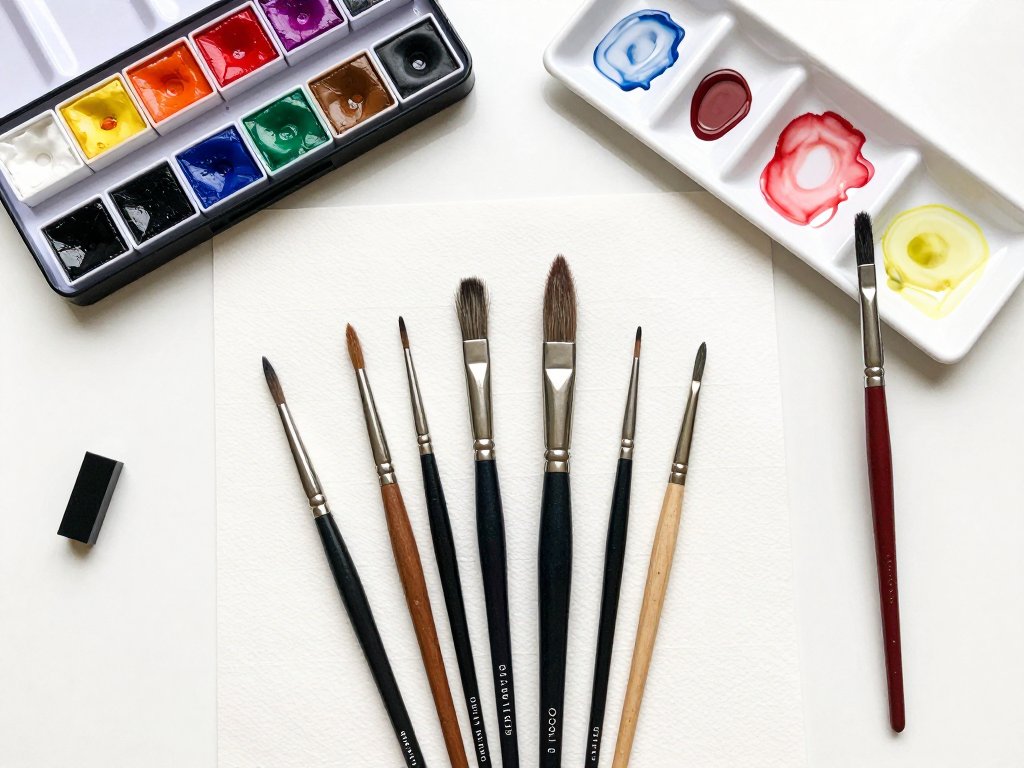
Before we talk about price tags and brand names, you need to understand what each brush shape does. Think of brush shapes as the vocabulary of your watercolor language — each one lets you say something different on paper.
Round Brushes: The Workhorse
If you could only own one watercolor brush for the rest of your life, make it a good round brush. Rounds are the most versatile shape in existence. They come to a fine, sharp point when wet, which means a single round can lay down a broad wash when you press down, then flick upward to paint a hairline branch or a signature. The belly of a round brush holds a surprising amount of water and pigment — that's called its water-holding capacity — which gives you long, uninterrupted strokes. For beginners, I recommend starting with at least three rounds: a size 4 (details and controlled strokes), a size 8 (your everyday workhorse), and a size 12 (broad washes and loose work).
Flat Brushes: The Builder
Flat brushes have a squared-off edge that makes them indispensable for bold, straight strokes, flat washes, and geometric shapes. You'll use flats to paint skies, large background washes, buildings, and anything that benefits from crisp edges. The width of the flat is measured in millimeters, not by a numbering system — so a 1/2-inch flat is roughly equivalent to a size 12 round in terms of coverage, but with a completely different personality. For a beginner kit, grab a 1/4-inch flat for small washes and a 1/2-inch or 3/4-inch flat for larger ones. The chisel edge of a flat brush is also brilliant for painting straight lines — think fence posts, window frames, and the edge of a horizon.
Filbert Brushes: The Blender
Imagine a flat brush that went to finishing school and learned some manners. That's a filbert — it has the broad belly of a flat but a rounded tip that softens every stroke. Filberts are exceptional for blending adjacent colors, softening edges, and painting organic shapes like flower petals, clouds, and rounded stones. They don't get enough love in beginner guides, but once you try a filbert for a wet-in-wet passage, you'll wonder how you ever lived without one. A size 10 filbert is a fantastic addition to any starter set.
Liner and Rigger Brushes: The Detailer
Named after their original use in marine painting (rigging, get it?), rigger brushes have extra-long bristles that hold a tremendous amount of thin paint, allowing you to pull long, continuous lines without reloading. Liners are similar but typically shorter. These are your go-to brushes for branches, grass, wires, hair, and any line work that demands flow and consistency. The magic of a rigger is that you can vary the pressure to create lines that swell and taper naturally — something a round brush struggles with at the tip. A size 0 or 1 rigger is a fine starting point.
Mop Brushes: The Soaker
Mops are the big, fluffy, cloud-like brushes that look like they were designed by someone who really loves soft things. They hold an absurd amount of water and pigment — we're talking the kind of water-holding capacity that lets you paint a full sky wash without dipping back into your jar. Mops are made for wet-on-wet techniques, softening edges, lifting pigment, and painting large atmospheric passages. They're not for detail work, and that's exactly the point. A size 6 or 8 mop (don't confuse the numbering — mop sizing runs differently than round sizing) is a luxury you'll appreciate on every single painting.
Wash Brushes: The Coverage King
Wash brushes sit somewhere between a flat and a mop in terms of shape. They're wide, often flat or slightly domed, and purpose-built for laying down even, uniform washes across large areas of paper. If you paint landscapes, you'll use a wash brush for every sky, every body of water, and every large shadow area. A 1-inch wash brush is an excellent investment for beginners working on quarter-sheet or half-sheet paper.
Angular Brushes: The Precision Cutter
Angular brushes have bristles cut at a slant, which gives you a sharp point at one corner and a broad edge at the other. That angular cut is surprisingly useful for painting curved shapes, filling corners, and creating varied line widths with a single tool. They're excellent for leaf shapes, architectural details, and calligraphic strokes. A size 4 or 6 angular brush adds a welcome dose of precision to any kit.
Detail Brushes: The Micro-Specialist
Detail brushes are essentially very small rounds (sizes 0, 00, and even 000) designed for the finest possible work — tiny highlights, minuscule branches, catchlights in eyes, and Signature work. While beginners often over-purchase detail brushes (thinking they need precision when really they need practice), having one good size 0 round is useful. Just don't fall into the trap of doing all your painting with a tiny brush — rescale your work with bigger tools and save the micro-brush for the finishing touches.
Brush Sizes: The Numbering System Demystified
Here's where things get confusing. Brush sizing follows a loose industry standard, but every manufacturer interprets it slightly differently. A size 8 round from Princeton is not identical to a size 8 round from Da Vinci. That said, here's the rough framework:
Small brushes (sizes 0–4) are for details, controlled strokes, and small work. Medium brushes (sizes 6–10) are your everyday painting tools — large enough to cover paper efficiently yet small enough to maintain control. Large brushes (sizes 12–24) are for washes, backgrounds, and loose expressive painting. Beyond size 24, you're in mop territory. The key takeaway: don't obsess over the number. Instead, look at the actual dimensions of the brush. Most reputable brands list the ferrule width and bristle length on their packaging or website. Use those numbers, not the size label, to compare brushes across brands.
For context: a Princeton size 8 round has a ferrule width of about 4.5 mm and a bristle length of about 22 mm. An Escoda size 8 round is slightly narrower at the ferrule but longer in the belly, giving it a different feel. Neither is wrong — they're just different tools for different hands.
Hair Types: The Soul of the Brush
The bristles are where the real magic happens. The hair type determines how a brush holds water, how it snaps back into shape, and how it feels on paper. Let me walk you through the main contenders.
Natural Kolinsky Sable: The Gold Standard
Kolinsky sable is the Ferrari of brush hairs. It comes from the tail of the male kolinsky (a type of weasel — don't worry, they're not endangered; the fur is a byproduct of the farming industry), and it possesses a combination of properties that synthetics still haven't perfectly replicated. Kolinsky sable has incredible snap — that springy resistance that makes the bristles return to a perfect point after every stroke. It also holds more water and pigment than any synthetic at a comparable size, and it wears beautifully over years of use. The downside? Price. A single kolinsky sable size 12 round from Winsor & Newton can cost $80–$120. For beginners, I recommend buying just one kolinsky sable — a size 8 round — as a treat and a reference point for what a truly good brush feels like. You'll train your hand even if you don't use it every day.
Synthetic Squirrel: The Affordable Softie
Synthetic squirrel hair mimics the extreme softness and water-holding capacity of natural squirrel hair (which, honestly, feels like painting with a cloud). Synthetic squirrel brushes are incredibly soft, hold massive amounts of water, and have almost no snap — they just flop into whatever shape you push them into. This makes them brilliant for wet-on-wet washes, blending, and soft atmospheric work but frustrating for anything requiring control or precision. Brands like Princeton make excellent synthetic squirrel mop brushes (their Neptune line is a standout) that cost a fraction of natural squirrel or kolinsky. For a beginner, a synthetic squirrel mop in size 6 is a dream tool for skies and backgrounds.
Synthetic Kolinsky: The Modern Marvel
Synthetic kolinsky bristles are engineered to replicate the snap, point, and water-holding capacity of real kolinsky sable. The technology has improved dramatically in the last five years — modern synthetics from brands like Da Vinci (their Casaneo line), Escoda (Versatil), and Princeton (Elite Micro) are shockingly good. They don't quite match the nuanced feel of natural sable, but they come close at a fraction of the cost — typically $8–$20 per brush instead of $40–$120. For a beginner's full set, synthetic kolinsky is my top recommendation. You get excellent performance, consistent quality, and none of the ethical concerns that some artists raise about animal hair brushes.
Synthetic Blends: The Best of Both
Blended brushes combine natural and synthetic hairs — typically a percentage of kolinsky or sable mixed with synthetic fibers to balance performance and price. A 50/50 blend, for instance, gives you much of the snap and water-holding of natural hair with the durability and lower cost of synthetic. Winsor & Newton's Cotman line is a classic example — affordable brushes that perform admirably for beginners. The trade-off is subtle: blends don't point quite as sharply as pure kolinsky, and they don't hold quite as much water, but for the price difference, it's a compromise worth making when you're building your set.
Budget Picks vs. Investment Picks
Let's talk money. A functional starter set of watercolor brushes can cost as little as $30, and you can also spend $300. Here's where I recommend you allocate your budget for maximum impact.
Budget Territory ($30–$60 for a starter set)
At this price point, you're looking at synthetic brushes from brands like Princeton (their Princeton Select and Princeton Neptune lines), Arteza (their EverBlend and Professional lines), and Royal & Langnickel. These brushes won't last a decade, and they won't have the snap of sable, but they'll absolutely get you painting. The Arteza Professional Watercolor Brush Set, for about $35, includes a well-curated selection of rounds, flats, and detailers that punch above their weight. I've tested them — they hold a reasonable point, shed minimally, and survive repeated washing. For a complete beginner, this is a perfectly fine place to start. You'll outgrow them in a year or so, but by then you'll know exactly which brush shapes you use most, making your upgrade purchases far more targeted.
Mid-Range Sweet Spot ($80–$150 for a curated set)
This is the sweet spot for serious beginners who want quality without the kolinsky price tag. At this level, you're looking at Princeton Elite Micro (synthetic kolinsky), Da Vinci Casaneo (their synthetic kolinsky line), and Winsor & Newton Cotman (synthetic blend). These brushes feel noticeably better than budget synthetics — better snap, better point, better water-holding capacity. They'll also last two to three years with proper care. I recommend starting here if you can afford it. A set of five Princeton Elite Micro brushes (sizes 4, 8, 12 rounds, a 1/2-inch flat, and a size 1 rigger) will run you about $100 and cover 90% of what you'll paint in your first year. That's money well spent.
Investment Picks ($200+)
If you're ready to commit and you know watercolor is your medium, investing in one or two natural kolinsky sable brushes is a rite of passage. Escoda (their Optimo line), Da Vinci (Series 10 Kolinsky), and Winsor & Newton (Series 7) make exceptional kolinsky brushes that, with care, will last ten years or more. Don't buy a full set — buy one size 8 round. Use it. Learn what a great brush can do. Let it teach your hand, and then add more pieces gradually. A single Escoda Optimo size 8 round costs about $55 — comparable to a high-end palette — and it will outperform any synthetic you've ever used. That one brush will change how you paint.
How to Care for Watercolor Brushes
Brushes are investments, even the inexpensive ones, and a few minutes of care after each session will dramatically extend their lifespan. Here's the routine I use and recommend.
Rinse Thoroughly Between Colors
Don't let pigment dry in the ferrule — that's the metal band that connects the bristles to the handle. When pigment dries in the ferrule, it pushes the bristles apart, ruining the brush's point permanently. Rinse your brush in clean water between colors, and swirl it gently — don't jam it into the bottom of your water jar. Agitation is fine; impact is not.
Use Brush Soap
Every few sessions, clean your brushes with dedicated brush soap. I use The Masters Brush Cleaner and Preserver — it's a small orange puck that costs about $8 and lasts for years. Wet the brush, swirl it in the soap, and work the lather into the bristles with your fingers, gently shaping the brush back to its original form. Rinse thoroughly. The soap conditions the bristles and removes pigment residue that plain water leaves behind.
Never Leave Brushes Tip-Down in Water
This is the fastest way to destroy a brush. When left tip-down in a jar, the bristles bend against the bottom and never fully recover. Always store your brushes horizontally or tip-up in a jar or brush case. After cleaning, lay them flat on a towel to dry — never stand them upright while wet, as water can seep into the ferrule and loosen the glue.
Shape While Damp
After you wash a brush, gently shape the tip with your fingers while it's still damp (not wet). For rounds, roll the brush between your fingers to form a point. For flats, pinch the bristles into a clean chisel edge. This muscle memory will keep your brushes performing at their best for years.
Store Safely
Invest in a brush roll or a protective case. Brushes rattling around in a drawer or bag will get their tips bent and damaged. A simple canvas roll costs $15 and will protect hundreds of dollars in brushes. The Princeton Brush Roll is a favorite — compact, well-padded, and available on any art supply site.
Recommended Brush Sets for Beginners in 2026
Here are my top recommendations for complete beginner brush sets, tested and vetted across every price tier.
Best Budget Set: Arteza Professional Watercolor Brushes (12-Pack)
Price: ~$35. Includes rounds, flats, filberts, and detailers in a range of sizes. The synthetics are surprisingly good for the price — decent snap, reasonable point, minimal shedding. You won't get the nuance of sable, but you'll get a full range of shapes to experiment with. The main weakness is the handles, which are a bit lightweight; they won't break, but they don't feel luxurious. For the price, this is the best starter set money can buy. Best for: absolute beginners testing the waters.
Best Mid-Range Set: Princeton Elite Micro Brush Set (6-Piece)
Price: ~$95. Includes sizes 4, 8, and 12 rounds, a 1/2-inch flat, a size 6 filbert, and a size 1 rigger. The Elite Micro fibers are synthetic kolinsky and they're genuinely excellent — nearly as much snap as natural sable, a beautiful fine point, and excellent water retention. These brushes are lightweight, well-balanced, and comfortable to hold for long sessions. I've painted with mine for over two years and they still perform like new. Best for: committed beginners who want professional performance without the price tag.
Best Premium Starter Set: Winsor & Newton Cotman Watercolour Brush Set (8-Piece)
Price: ~$110. Winsor & Newton's Cotman line is a classic for good reason. These are synthetic-blend brushes — not pure sable, but a carefully engineered mix that gives you excellent snap and point-holding at a reasonable price. The set includes a well-chosen selection of rounds, flats, and detailers packaged in a sturdy plastic case. The handles are blue, which makes them easy to spot in your water jar. Best for: beginners who want a brand they can trust to carry into professional work.
Best Investment Starter: Escoda Versatil Set (6-Piece) + One Kolinsky
Price: ~$140. Escoda's Versatil brushes are synthetic kolinsky and they're as close to natural as I've ever found. I pair this set with a single Escoda Optimo kolinsky size 8 round (add about $55) for the best possible beginner setup. The Versatils handle 95% of everyday painting; the kolinsky round is your reference-grade tool for the work that matters most. Best for: the beginner who knows this is a lifelong pursuit and wants to start right.
Three Brushes You Can Skip (For Now)
I promised I'd tell you which brushes to ignore, so here goes. Fan brushes — those spread-out, flat brushes shaped like a hand fan — are popular for drybrushing texture but they're a one-trick pony that beginners rarely need. Dagger brushes (also called bark brushes) have an angled tip for specific stroke effects that are better learned with a round and a flat. And comb brushes — with notched bristles for creating parallel lines — are a gimmick. Master the fundamentals with rounds, flats, and filberts before you explore specialty shapes.
Final Thoughts: Buy Small, Learn Big
The most important thing I can tell you, after years of buying, testing, and occasionally regretting brush purchases, is this: don't overbuy on your first trip. Start with three to five quality brushes in versatile shapes — a size 8 round, a size 12 round, a 1/2-inch flat, a size 6 filbert, and a size 1 rigger. Learn what each one can do. Spend a month painting with only these brushes. Push them beyond what you think they're capable of. You'll discover that a round brush can paint a wash, a branch, a flower petal, and your signature with the same belly and tip — and that knowledge is worth more than any brush-shaped object you can buy.
Watercolor is a conversation between you, your brush, the water, and the paper. The brush is your voice. Choose one that speaks clearly, that responds to the lightest pressure and the heaviest soak, that comes back to a perfect point no matter how many times you push it out of shape. You don't need a dozen brushes to start a beautiful conversation — you just need the right few.
Now go paint something. The brushes are waiting.