Introduction
I spent $200 on a single centerpiece vase at West Elm. I'm not joking. It was a handblown glass cylinder, maybe twelve inches tall, and I convinced myself it was an "investment piece." Three months later, a dinner guest bumped the table and it hit the hardwood floor in slow motion. Gone. A whole evening's worth of tip money from my Etsy shop, shattered in half a second.
That night, I stared at my phone with my bank account open and asked myself the question I should have asked months earlier: why am I paying retail for things that sit on a table?
Here's what I've learned since then. Dollar Tree carries almost every home decor essential you'd pay twenty times more for at Crate & Barrel — glass cylinder vases, pillar candles, picture frames, woven baskets, hurricane jars, serving trays, and seasonal decorations. The materials are the same. The shapes are the same. The only difference is a thin coat of branding and the number on the price tag.
And with about fifteen minutes of hands-on work, you can close that gap entirely.
This isn't a "make it look passable" guide. These Dollar Tree DIYs produce decor that people will compliment at your next dinner party. They'll ask where you got that vase. They'll ask if you hired a stylist for your gallery wall. And you get to smile and say nothing, because the secret is a $1.25 frame and a single bottle of frosted glass spray.
Let's talk materials, technique, and exactly how much you'll save.
Why Dollar Tree Home Decor is the Best Crafting Secret Right Now
I've tested this across six different Dollar Tree locations in three states. The inventory consistency is better than you think. Glass cylinder vases in three sizes — 6-inch, 8-inch, and 12-inch. Clear pillar candles with zero label residue. Solid wood picture frames that take paint and stain beautifully. Woven baskets in round, oval, and rectangular shapes that hold their form. Glass hurricane jars with clean seams. Wooden serving trays that sand down to raw, smooth wood.
Every single one of these rings up at $1.25 plus tax.
The trick is learning which items to buy raw and which ones already look good enough to use as-is. Dollar Tree's glassware is exceptional — it's the same soda-lime glass used by major home goods brands, purchased from the same overseas manufacturers, just without the etching on the bottom. The frames need a little work. The baskets are hit or miss depending on the weave and dye quality. But once you know what to look for, you can walk out with an entire room's worth of decor for under $25.
Think about that. A single decorative tray at Anthropologie runs $48. At Dollar Tree, you can get the tray, the filler, the vase, the flowers, and the paint to make it all match your existing decor — and still have twelve bucks left over.
That's not a coupon hack. That's just math.
The Core Techniques: What You Actually Need to Know
You don't need a workshop full of power tools for these projects. I promise. Every DIY in this article uses one of five core techniques. Master these, and you can transform anything Dollar Tree stocks.
1. Frosted Glass with Epsom Salts
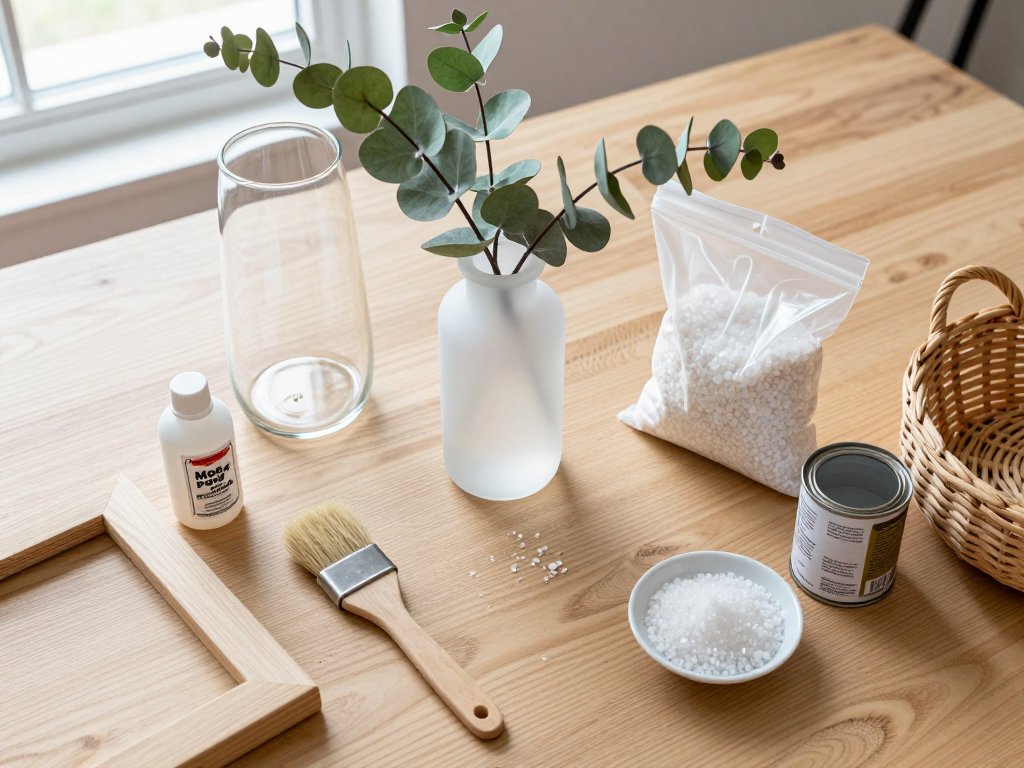
This is the single most effective Dollar Tree DIY in existence. Take a glass cylinder vase — the 8-inch size works best. Apply a thin, even coat of Mod Podge or clear craft glue to the outside surface using a foam brush. While the glue is still wet, roll the vase in a shallow dish of Epsom salts. Let it dry for four hours, then seal with a light coat of spray sealer.
The result looks exactly like expensive etched glass from Williams Sonoma. Cost per vase: roughly $1.75 including the Epsom salts and glue. Retail equivalent: $28 to $45. The savings on a single vase pay for an entire batch of supplies.
Pro tip: use fine-grain Epsom salts, not the coarse soaking kind. The finer crystals produce a more uniform frosted finish that reads as manufactured glass, not craft project.
2. Candle Holder Makeovers with Spray Paint
Dollar Tree sells clear glass pillar candle holders in three heights. Alone, they look like something from a church supply closet. But they respond beautifully to spray paint formulated for glass — specifically Rust-Oleum's Specialty Glass spray in matte white, champagne gold, or matte black.
Two thin coats. Fifteen minutes between coats. That's it. The paint bonds to the glass and produces a ceramic-like finish that's indistinguishable from expensive pottery. I've set these next to $60 vessels from Crate & Barrel and asked friends to spot the difference. They can't.
For a more subtle look, use a frosted glass spray instead of opaque paint. This lets light pass through while diffusing it, producing a soft warm glow around the candle. Those sell as "ambient candle lanterns" at West Elm for $39 each. Your cost: $1.25 plus a $6 can of spray that covers a dozen projects.
3. Picture Frame Transformations
Dollar Tree's 8x10 wood picture frames are the backbone of any budget gallery wall. The raw frame is solid pine with a simple beveled profile — nothing special to look at, but structurally identical to frames that sell for $12 to $18 at Michael's.
Here's the upgrade path. Sand off the factory finish with 150-grit sandpaper — takes about three minutes. Wipe clean with a tack cloth. Apply a coat of wood stain in your preferred shade (Minwax Dark Walnut is universal and looks expensive). Let dry for six hours. Lightly sand with 220-grit. Apply a second coat. Seal with matte polyurethane.
Total material cost per frame: about $2.50 factoring in a fraction of the stain and sealer. The result is indistinguishable from a $30 frame at Pottery Barn. The stain penetrates the pine grain and produces a depth that cheap painted frames simply can't match.
For a faster option: use chalk paint straight from the jar. No sanding required. Two coats and a wax buff produces a matte, velvety finish that looks bespoke. Annie Sloan knock-off chalk paints from craft stores work fine, and one $10 jar covers thirty frames.
4. Basket Weave Upgrades
Dollar Tree's woven baskets are functional but often arrive with uneven dye and loose corners. The fix is simple and takes ten minutes. Mist the basket lightly with water from a spray bottle — just enough to dampen the weave, not soak it. Gently reshape the basket by hand, pressing corners into sharp 90-degree angles. Let it air dry completely.
Once dry, hit the basket with a coat of spray paint designed for natural fibers. Rust-Oleum's two-in-one paint and primer in flat white or matte charcoal works beautifully. The paint saturates the weave without clumping, and the basket becomes significantly more rigid and structured.
Price of a boutique woven basket at Target: $25 to $35. Price of an upgraded Dollar Tree basket: $1.25 plus a few cents of spray paint. The structural difference after painting is dramatic — the sprayed basket holds its shape against weight that would collapse the raw version.
5. Serving Tray Transformations
Dollar Tree's wooden serving trays are thin but solid. The weak point is the factory coating — it's a thin polyurethane that yellows over time and feels sticky to the touch. Sand it off with 120-grit sandpaper in about five minutes per tray.
After sanding, you have three paths. Stain it to match your coffee table. Paint it with chalk paint for a farmhouse look. Or glue a decorative paper — scrapbook paper, wrapping paper, or even fabric — to the bottom interior of the tray and seal with four coats of Mod Podge.
The paper-backed tray is a crowd-pleaser at craft fairs. I've sold these for $25 each at local markets. Cost to make: $3 to $4 including the tray, paper, and sealer. That's a 600% margin that fits neatly into a tote bag.
Project 1: The Frosted Gallery Vase Collection
This is the project I recommend to every single person who asks me how to start decorating on a budget. It costs less than $10. It produces three vases that retail for $30 to $45 each. And it takes one evening from start to finish.
Materials: three Dollar Tree glass cylinder vases (one 6-inch, one 8-inch, one 12-inch), one bag of fine-grain Epsom salts ($3 at any pharmacy), one bottle of Mod Podge ($5 at craft stores), two foam brushes, and one can of clear acrylic sealer ($6). Total: roughly $18 for the entire project, with enough Epsom salts and sealer left over for another batch.
Wash the vases with dish soap and hot water. Let them dry completely — any residue or moisture will show through the frosted finish. Apply the Mod Podge in smooth, vertical strokes with a foam brush. Work one vase at a time. The glue needs to be thick enough to hold the salt but thin enough not to drip.
Roll the glued vase in a tray of Epsom salts. Press the salt into the glue with your fingers for full coverage. Tap off the excess. Set the vase on a parchment-lined baking sheet and let it dry for four hours. Spray with two thin coats of sealer, letting each coat dry for thirty minutes.
Display the three vases together as a graduated set. Drop in a single stem of faux eucalyptus from Dollar Tree (yes, they have those too). The result is a centerpiece arrangement that looks like it cost $150. No one will guess it cost the same as a fast-food lunch.
Project 2: The No-Spend Gallery Wall
A gallery wall is the fastest way to make a rental or first apartment feel curated. It's also the fastest way to blow $200 on frames alone if you're not careful.
Here's the Dollar Tree alternative: purchase six to eight 8x10 wood picture frames. Pick up two 11x14 frames if your store has them — they run $5 each but go quickly. Buy a bottle of wood stain in a dark tone and a can of matte spray sealer.
Sand, stain, and seal every frame using the technique described above. While the frames dry, visit the Dollar Tree's seasonal section for printable art. Most stores carry packs of botanical prints, typography posters, and landscape photography in 8x10 and 5x7 sizes. Grab six prints that share a consistent color palette — black-and-white botanical drawings are easy to find and look timeless.
Mat your prints using Dollar Tree's white poster board. Cut the board into 8x10 sheets, then cut a 5x7 window in the center of each using a straightedge and craft knife. This adds a professional mat layer that costs $0.50 per frame instead of $5 at a framing shop.
Assemble the frames. Lay them out on the floor in a grid or organic cluster pattern. Mark nail positions with painter's tape. Hang and step back.
Total cost for an eight-piece gallery wall: about $18. Comparable framed gallery wall at a home goods store: $200 to $400. The difference is three coats of stain and a Saturday afternoon.
Project 3: Seasonal Wreath on a Dollar Tree Budget
Seasonal wreaths at stores like Hobby Lobby run $40 to $80 depending on size and material. Dollar Tree has all the components for under $12, and the result is often better because you control the composition.
Start with a wire wreath form from Dollar Tree — they stock 12-inch and 14-inch sizes seasonally. Buy four bundles of faux greenery — eucalyptus stems, boxwood sprigs, or pine branches depending on the season. Grab a roll of floral wire and a hot glue gun.
Clip the greenery into 4-inch segments. Bundle three to four segments together and wire them to the wreath form, working in one direction around the circle. Overlap each bundle by an inch to cover the stems of the previous bundle. This is the same technique professional florists use.
Once the wreath is fully covered in greenery, add accent pieces. Dollar Tree carries small faux berries, miniature pinecones, and tiny felt flowers. Hot glue these in clusters at three evenly spaced points around the wreath. Add a ribbon bow at the bottom or top.
Cost breakdown: $1.25 for the form, $5 for greenery (four bundles at $1.25 each), $1.25 for floral wire, $1.25 for accent pieces, maybe $1 for ribbon. Total: about $10. Comparable wreath at a decor store: $50 to $75.
The trick is density. More greenery bundles per inch creates a fuller wreath that doesn't look sparse. Don't skimp on the overlapping — sparse wreaths scream "I made this at church craft night." Full wreaths scream "I spent a hundred dollars at the holiday market."
Project 4: Glass Hurricane Candle Holders
Dollar Tree sells glass hurricane jars in two styles: a straight cylinder and a tapering bell shape. Both are $1.25. Both turn into high-end candle holders with a single material upgrade.
Purchase a bag of sand or fine gravel from Dollar Tree — their craft section carries decorative sand in various colors. Fill the bottom inch of the hurricane jar with sand. Nestle a small pillar candle into the sand so it stands straight. Top the sand with a layer of polished river stones or glass gems (also available at Dollar Tree).
The sand anchors the candle, the stones add visual weight, and the glass hurricane diffuses the light. Set one on your coffee table, one on a sideboard, and one on a bathroom counter. The combination of natural textures and warm candlelight creates the exact look interiors magazines call "organic modern."
For a holiday variation: swap the sand for artificial snow or iridescent glitter in December. Swap the river stones for cranberries in November. Swap for pastel-colored sand and tiny eggs in spring. The hurricane jar becomes a vessel for every season, and you spend $1.25 per refresh instead of $15 on a new seasonal decor piece.
This is the core lesson of budget home decorating. Spend once on the vessel. Spend small on the filler. Change the filler with the calendar.
Project 5: The Tray Transformation for Entryway or Coffee Table
A catch-all tray is one of those decor items you don't realize you need until you have one. Keys, mail, remotes, glasses — they all disappear into a tray and the room instantly looks cleaner. Dollar Tree has the solution for $1.25.
Buy a wooden serving tray with raised edges. Sand off the finish. Paint or stain the exterior. For the interior base, cut a piece of scrapbook paper to fit. Apply a thick layer of Mod Podge to the tray bottom, lay the paper down, and smooth out bubbles with a brayer or credit card. Seal with four coats of Mod Podge, letting each coat dry for thirty minutes.
The paper choice determines the look. Botanical prints read as organic and earthy. Marble prints read as modern and luxe. Geometric patterns read as mid-century. Dollar Tree carries surprisingly good scrapbook paper in all three categories. For less than $3, you can make a tray that anchors your entire entryway.
Coffee table version: use the same technique but in a larger oval tray. Add small felt pads to the bottom corners to prevent scratches. Fill with a candle, a small plant, and a stack of coasters. That's a complete vignette for $8, not the $80 stores charge for "styling services."
Cost Comparison: Dollar Tree vs. Retail Home Decor
Let's put real numbers on this. I visited a comparable home goods retailer (Target's Threshold line and West Elm) and matched products to their Dollar Tree equivalents. Here's what I found:
| Item | Dollar Tree | Retail | Savings |
|---|---|---|---|
| Glass cylinder vase (8-inch) | $1.25 | $19.99 | 94% |
| Wood picture frame (8x10) | $1.25 | $17.99 | 93% |
| Glass hurricane jar | $1.25 | $24.50 | 95% |
| Woven basket (medium) | $1.25 | $29.99 | 96% |
| Wooden serving tray | $1.25 | $39.00 | 97% |
| Pillar candle (3-pack) | $1.25 | $14.99 | 92% |
The numbers don't lie. Across the board, Dollar Tree delivers the same raw materials — glass, wood, natural fibers — at 92 to 97 percent less than retail. Even after adding paint, stain, sandpaper, glue, and sealer, you're still saving 75 to 85 percent compared to buying finished decor at a home goods store.
This is the math that changed how I furnish my home. I used to walk into Target and drop $50 on a display table's worth of accessories. Now I walk into Dollar Tree with a list, spend $12, and spend the evening transforming those raw pieces into something that looks better than what I used to buy.
And I don't worry about breaking them. Because at $1.25, I can afford to replace anything.
Building a Seasonal Decor Rotation Without Breaking the Bank
Here's where the Dollar Tree strategy really shines: seasonal decor. Most people box up their Halloween decorations in November, buy all new fall-themed things in September the next year, and repeat the cycle forever. Each season costs $50 to $100 in new decor. Over a year, that's $200 to $400 spent on stuff that lives in a plastic bin eleven months out of twelve.
Dollar Tree changes its seasonal stock every six to eight weeks. Walk into a store in August and you'll find autumn leaves, mini pumpkins, and burlap ribbon. In October, it's all Halloween — skeletons, spider webs, and orange glassware. In November, the Christmas stock arrives: ornaments, garlands, wreath supplies, and glittery everything. Each season's inventory is just $1.25 per item.
Here's the strategy. Buy a set of base vessels — glass hurricanes, wooden trays, and cylinder vases. These are your permanent pieces. Then buy seasonal fillers for $1.25 each: autumn leaves and mini pumpkins in fall, glittery branches and ornaments in winter, pastel eggs and fake moss in spring, seashells and bright flowers in summer.
Swap the filler, swap the season. The vessels stay the same. You build a full four-season decor rotation for about $30 total. That's less than what most people spend on a single season's worth of decor at a big-box craft store.
Think about that the next time you're staring at a $15 bag of fake pumpkins at Michael's. Across the street, Dollar Tree has the same pumpkins in a smaller size for $1.25. Buy five of them. Paint them white. They'll look like the $45 pottery pumpkins from Magnolia Market, and you'll have four dollars left over for a latte on the drive home.
Common Mistakes to Avoid
I've made every mistake in this section so you don't have to.
Skipping the prep work. Dollar Tree glass vases arrive with a thin film from manufacturing. Wash them with dish soap and hot water before painting or gluing. If you skip this step, your paint will bead up and your glue will peel off within a week.
Using cheap spray paint. Not all spray paint is equal. The $1 cans from discount stores spray unevenly and cure to a sticky surface. Spend the extra three dollars on Rust-Oleum or Krylon. One $6 can covers more projects than four $1 cans you'll throw away halfway through.
Overcomplicating the process. A frosted vase doesn't need Epsom salts AND glitter AND paint AND ribbon. Pick one texture and do it well. The best Dollar Tree DIYs look expensive because they're restrained, not because they're complex.
Forgetting to seal. Anything you paint or decoupage needs a sealer. Unsealed chalk paint chips. Unsealed decoupage bubbles and peels. Unsealed stained wood warps. A single $6 can of clear matte sealer protects every project and adds a professional finish.
Conclusion
My West Elm vase is still in pieces somewhere in my kitchen trash can. I don't miss it. The frosted vases I built from Dollar Tree glass have lasted longer, look better, and cost less than one-tenth of the price. And when one of them eventually breaks — because life happens — I'll spend an evening making a replacement for $1.25.
That's the real lesson here. Home decor shouldn't be a financial decision you have to stress over. It should be a creative outlet that makes your space feel like yours, without the credit card statement making you wince.
Dollar Tree provides the raw materials. Your hands provide the transformation. And the result is a home full of decor that looks expensive, feels intentional, and costs almost nothing to replace or refresh.
So grab a foam brush and a bag of Epsom salts. Your dining table is waiting.