Introduction
There is a particular kind of tired that mothers know well. It is the tired that comes from a day of being needed — the school run, the emails, the laundry, the endless small questions.
And when you finally sit down, your mind keeps spinning even though your body has stopped.
I have spent many evenings in that exact state. And the thing that helps me most is not another list, another plan, or another podcast about productivity. It is my hands.
Picking up a piece of yarn, a brush, or a ball of clay changes something.
It gives your mind one single thing to do, and that single thing is enough.
This article is about why making things helps — not in a vague, aspirational way, but in the practical, tea-cup-in-one-hand, ten-minutes-before-bed way that busy women actually live.
Before we begin, a gentle question: what did you love making as a child, before anyone told you whether you were good at it?
Why Making Things Calms the Brain
There is a reason crafters have always described their work as soothing. When your hands are busy with a repetitive, gentle motion — a knit stitch, a brushstroke, the smooth pull of a pottery wheel — your attention narrows to the present moment.
Psychologists call this state "flow," and it is the opposite of the scattered, spinning feeling that comes with a stressful day. In flow, there is no room for the worry about tomorrow's meeting or the argument from this morning. There is only the stitch in front of you.
For mothers, this matters even more. So much of our day is spent doing things for other people, with our attention pulled in six directions at once.
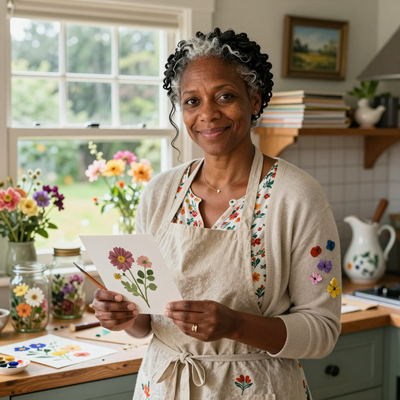
Crafting is one of the few activities that is genuinely single-task. Nobody needs anything from you while you are painting a line of leaves.
The world can wait.
There is also something quietly powerful about making a physical object. In a day when so much of our work is invisible — the wiped counters, the folded laundry, the emotional labor that no one sees — a finished scarf or a painted card is proof.
It is evidence that you made something real, with your own two hands.
That feeling is not frivolous. It is a small, reliable source of accomplishment that costs nothing and is available every single day.
What the Research Says, Gently
Let us be honest about research: it is comforting, but it is not the whole story. Still, the studies are worth knowing, because they give words to what crafters have always felt.
Researchers have found that engaging in creative activities is linked to lower reported stress and better mood. Occupational therapists have used crafts for over a century, not as a way to fill time, but as a meaningful activity that rebuilds focus, coordination, and confidence after illness or injury.
Knitting studies are the most quoted, and for good reason. People who knit regularly report that it helps them relax, keeps their minds occupied, and gives them a sense of purpose — especially when they knit for others.
Even the simple physical rhythm matters. Repetitive hand movements — the kind used in knitting, crochet, and beadwork — have a naturally calming effect on the nervous system. Some researchers compare it to the rhythm of breathing exercises or walking meditation.
Here is my gentle translation of all this: you do not need to be good at crafting for it to work.
The benefit lives in the doing, not in the result. That is the most freeing sentence in this entire article, so I will say it again: the benefit lives in the doing, not in the result.
The Calm Crafts: What to Try First
If you have not crafted in years, the biggest hurdle is deciding what to try. Here is a short tour of crafts that are especially well suited to a calm, beginner-friendly session. Pick the one that makes your shoulders drop a little when you read about it.
- Knitting or crochet. The rhythm is the medicine. Even a simple scarf in garter stitch — just one stitch repeated — gives you the full calming benefit. Start with a chunky yarn and big needles so every row grows quickly.
- Watercolor painting. Watercolor is famously forgiving because it is mostly water. Wet the paper, drop in some color, and watch what happens. There is no wrong way to paint a sky.
- Coloring. A coloring book and a set of pencils may feel simple, but choosing colors and staying inside the lines is deeply absorbing. It is also the easiest craft to do alongside a sleeping baby or a watching teenager.
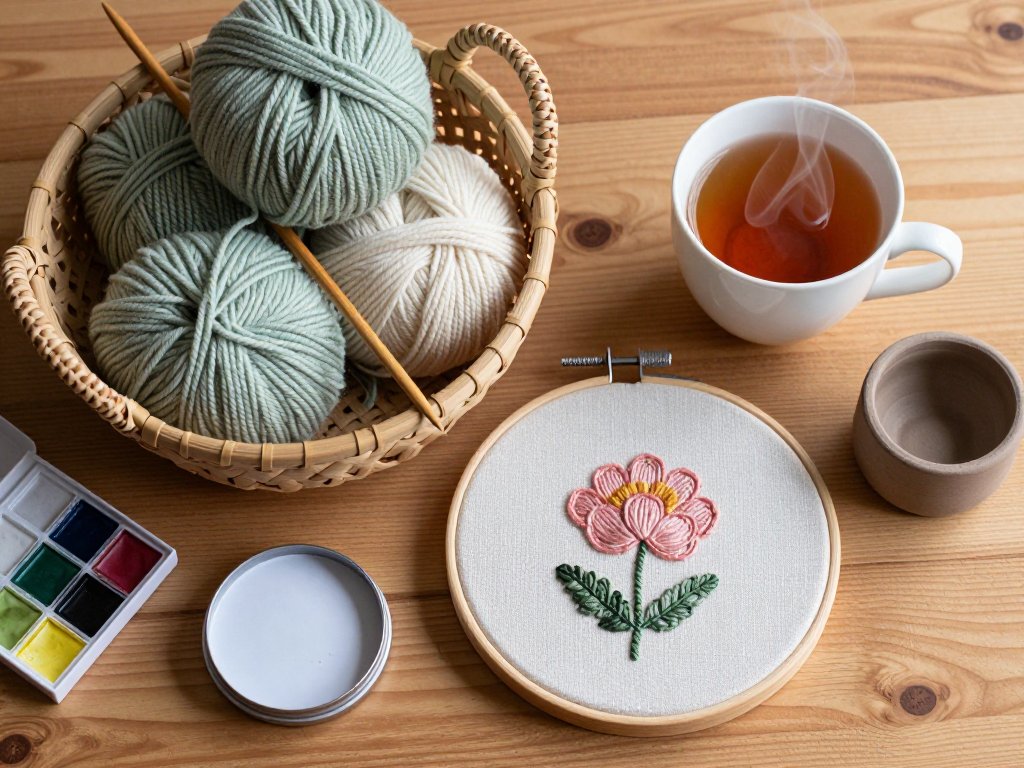
- Embroidery. One hoop, one needle, one color of thread. The slow, deliberate stitches are almost meditative, and a single flower can be finished in one evening.
- Hand-building with clay. No wheel required. Pinch a small bowl, press textures into it with a fork, and let it dry. The feel of clay under your fingers is grounding in a way that is hard to describe.
Notice what these crafts have in common: they are portable, inexpensive to start, and impossible to do badly in a way that matters. There is no audience, no grade, no deadline.
The Five-Minute Craft Habit
Here is the truth about busy mothers and hobbies: we do not have two-hour blocks, and waiting for one means never starting. The solution is embarrassingly simple. Craft in five-minute pockets.
Five minutes is enough to knit two rows. It is enough to paint one small leaf. It is enough to choose the colors for a card or roll a single bead of clay. And five minutes of absorbed attention is worth more than an hour of distracted half-doing.
To make this work, you need to remove friction. That means keeping your craft where you can see it. A basket by the sofa with yarn and needles inside. A small tin of watercolors on the kitchen windowsill. A hoop and thread in the car for school pickup waiting time.
I keep my current project in a basket next to my chair. When the kettle boils, I knit one row.
When the show ends, I knit two more. By the end of the week, there is a scarf, and I did not "find time" for it — I simply used the time that was already there.
What is one five-minute pocket in your day that could hold a few stitches?
Crafting with Kids: Shared Calm
One of the loveliest discoveries of mothering is that calm is contagious. When you sit down to make something, children often drift toward you, curious and quiet.
You do not need a planned "craft activity" with supplies and instructions. Sometimes the simplest shared making is the best: you knit while your child draws beside you.
You paint a watercolor wash while they squeeze their own colors onto a scrap of paper.
You sort buttons by color together, which is secretly a craft and secretly a calming activity all at once.
The magic of this is that it models something important. Your children see that making things is a normal way to spend an evening — not a performance, not a chore, just a pleasant way to be.
They absorb the lesson that hands can be quiet and busy at the same time.
And when they show you their drawing, resist the urge to improve it. The point is not the product. The point is that you were both making, together, in the same warm room.
When You Do Not Feel Like Making Anything
Let us be honest about the other days. Some days you are too tired to pick up a needle, and that is allowed. Crafting is not another obligation to add to your list. It is a resource you can draw on, and resources are allowed to sit unused.
On those flat days, there are still gentle ways to be near your craft without demanding anything from yourself.
Organize your yarn by color. Lay out your paints and admire them. Flip through a craft book or scroll pictures of finished projects.
This is not wasting time — it is keeping the door open so that when the energy returns, the path is still there.
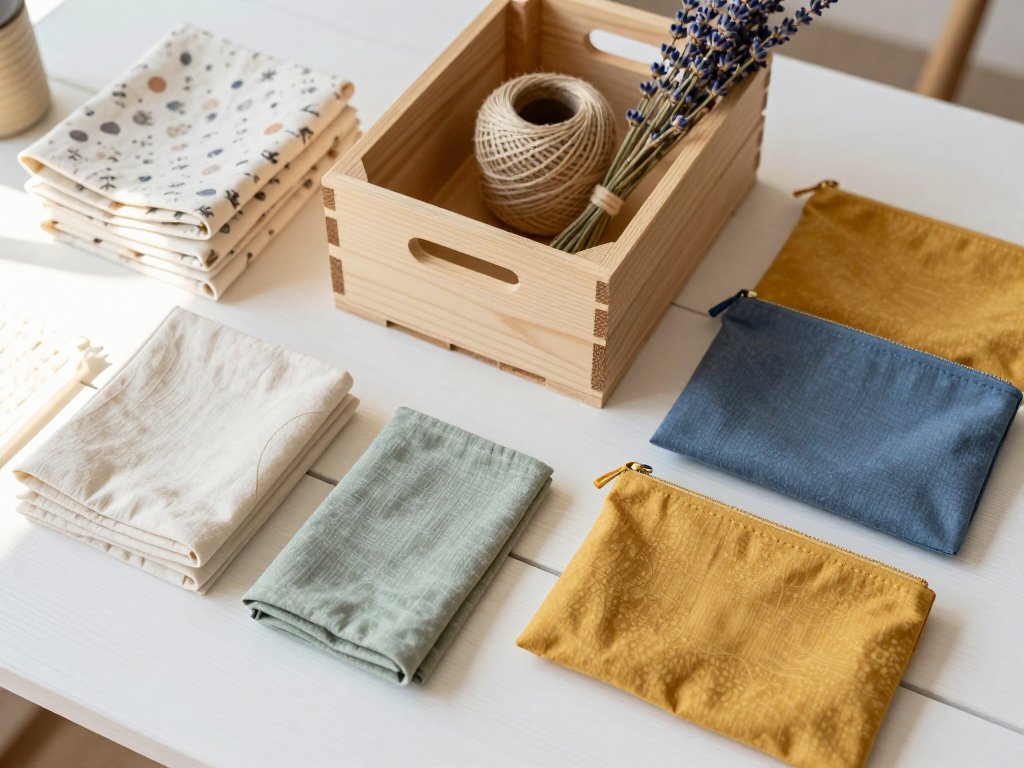
I have a drawer I call my "quiet drawer" — scraps of fabric, a half-finished embroidery hoop, a tin of beads.
On low days I simply open it and look. Often that is enough to remind me that I am a person who makes things, even on days when I am not making anything.
There is no shame in resting. The craft will be there tomorrow.
Some mothers find that soft music helps on these days. A playlist of calm songs while you sort supplies can gently shift the mood without asking anything of your hands at all. You are still keeping company with your craft, and that counts as tending the door.
Making Room for Making: A Simple Setup
You do not need a studio. You need a corner. But a little thought about where you craft makes a surprising difference to how often you actually do it.
- Choose one spot. The kitchen table, a corner of the bedroom, or the armchair by the window. Your brain will learn to relax the moment you sit there.
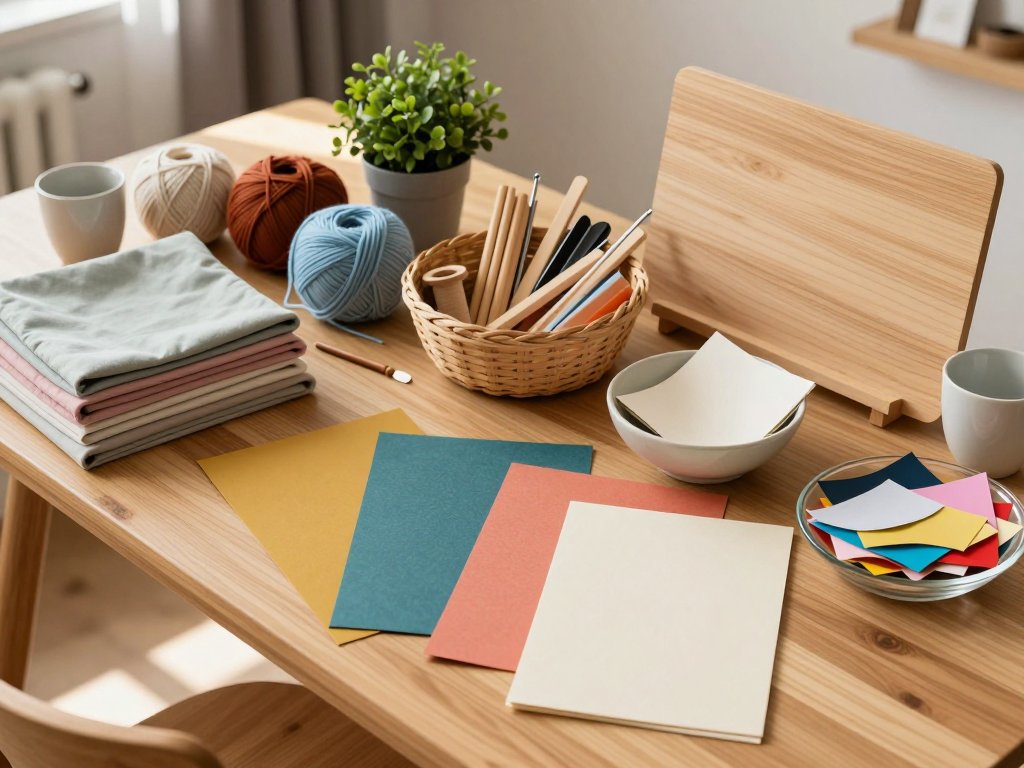
- Keep supplies visible. A basket, a tray, or a single shelf. Out of sight really does mean out of mind, and the opposite is also true.
- Add a lamp. Good light makes a craft feel inviting instead of straining. A warm lamp by your chair changes everything.
- Have a stopping ritual. A box you can close, a tray you can slide under the sofa. Knowing cleanup takes thirty seconds removes the last excuse.
When your supplies are ready and waiting, the five-minute pockets find you. When they are buried in a cupboard, the pockets slip away unused.
If space is truly tight, a single tote bag can be a studio. Tuck your current project, a small tin of supplies, and a cushion into one bag that lives by the door, ready for a quiet corner anywhere. The ritual matters more than the room.
Your First Calm Session: A Gentle Walkthrough
If you would like a place to begin, here is a first session that takes about fifteen minutes and requires almost nothing. It is the session I give to friends who say they are "not crafty."
- Put the kettle on. Make a cup of tea, the way you like it. This is part of the ritual, not a side note.
- Set up your spot. Clear a small space, turn on your lamp, and sit down. Put your phone in another room, or at least face-down and out of reach.
- Choose the simplest possible task. If you are painting: one leaf, one wash of color. If you are knitting: ten rows of garter stitch. If you are unsure: color one small page.
- Set a timer for ten minutes. You are allowed to stop when it rings. You are also allowed to keep going, but the timer removes the guilt either way.
- Notice what your hands are doing. The feel of the yarn, the glide of the brush, the scratch of the pencil. When your mind wanders, bring it back to the motion.
When the timer rings, look at what you made — even if it is imperfect, even if it is small. You did not finish a project. You did something quieter. You spent ten minutes doing one thing, with your whole attention, and that is a gift you gave yourself.
Conclusion
The word "therapy" can feel clinical, but the truth is gentler. Making things helps because it returns you to yourself — to the child who painted without worrying, to the person who exists outside of to-do lists and expectations.
You do not need talent. You do not need time you do not have. You need a small supply within reach and permission to use it badly.
So tonight, when the house finally goes quiet, I hope you give yourself ten minutes. Choose one craft, make one small thing, and let your hands do the thinking for a while.
And when you finish, you might find that the spinning in your mind has slowed — not because the day changed, but because you remembered that you are a maker. That is a truth worth keeping close, one stitch at a time.