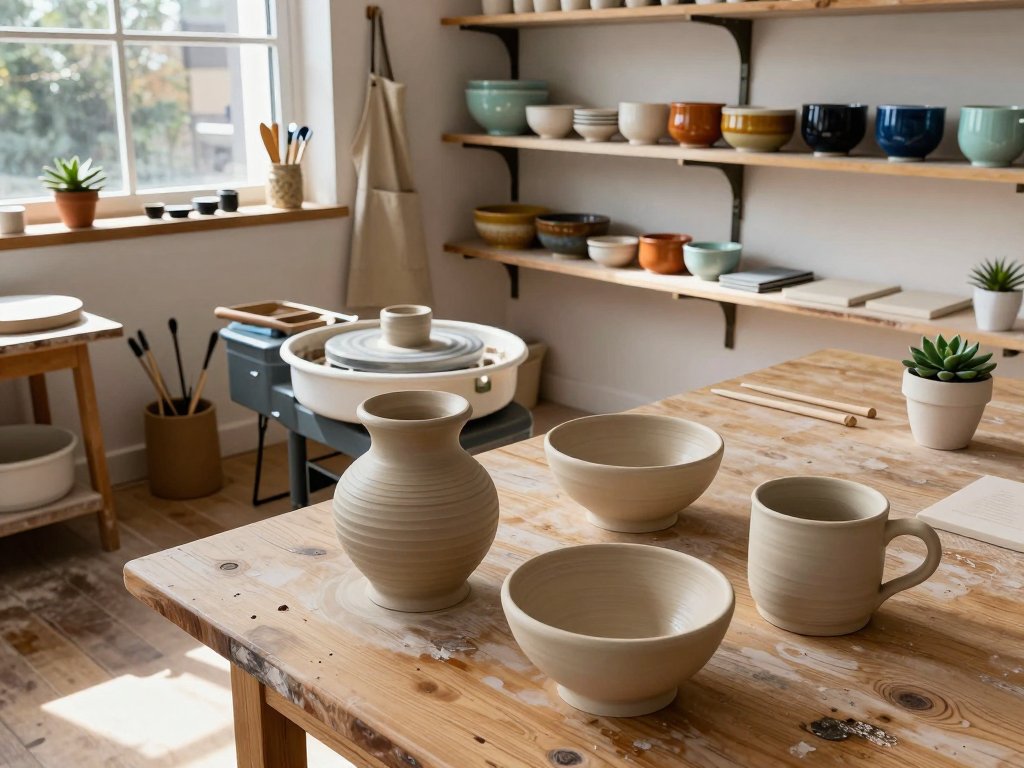
Introduction: A Quiet Revolution in Clay
Walk into any community pottery studio on a Tuesday evening in 2026 and you will find something remarkable.
A hedge fund manager in her forties sits shoulder-to-shoulder with a nineteen-year-old art student, both of them elbow-deep in wet clay.
A retired couple shares a wheel, laughing as a cylinder collapses for the third time.
A software engineer who spends his days training large language models is meticulously carving a sgraffito pattern into a leather-hard mug, his phone silenced and forgotten in his jacket pocket.
This scene repeats itself from Brooklyn to Berlin, from Seoul to Sydney. Pottery — one of humanity's oldest crafts, with roots stretching back more than twenty thousand years to the fired figurines of the Upper Paleolithic — is experiencing a boom unlike anything the ceramics world has seen since the studio pottery movement of the mid-twentieth century.
Clay studios report months-long waitlists for classes. Kiln manufacturers cannot keep up with demand. Online ceramics courses have seen enrollment triple since 2022.
And the demographic range is staggering: Generation Z, Millennials, Gen X, and Boomers are all flocking to the wheel and the worktable in numbers that industry insiders describe as unprecedented.
What is driving this resurgence? The answer is layered, textured, and surprisingly profound — much like the craft itself.
The Burnout Generation Finds the Wheel
To understand why pottery is having its moment, we must first understand the particular flavor of exhaustion that defines life in the mid-2020s.
We are, collectively, tired in ways that feel structural. The always-on notification culture. The endless scroll.
The creeping sense that artificial intelligence is coming for creative professions, that the very concept of human-made value is being questioned by the machines we built.
"I spend all day looking at screens and managing algorithms," says Maya Chen, a 32-year-old UX designer who took up pottery eighteen months ago at a studio in Portland, Oregon.
"When I sit down at the wheel, there is no algorithm. There is no prompt, no optimization, no metric.
There is just my hands and the clay, and if I try to rush it, the clay lets me know immediately."
This sentiment echoes through conversations with potters of all ages. The appeal of clay in 2026 is, at its core, an appeal to the real.
In a world where generative AI can produce photorealistic images, compose music, write essays, and even throw virtual pots in simulation software, the actual act of shaping physical matter with one's own hands has acquired a new kind of value.
It is not that pottery is a rejection of technology — most potters use Instagram to share their work and YouTube to learn new techniques — but rather that it offers a necessary counterbalance.
It is a tangible, tactile antidote to the disembodied digital existence that now defines so much of modern life.
The psychological literature backs this up. Research on "flow states" — those moments of deep, immersive concentration that psychologists identify as central to human well-being — consistently ranks tactile, hands-on activities among the most effective pathways to flow.
Pottery, with its demand for full sensory engagement, is a near-perfect flow generator. You cannot center a pot while thinking about your email backlog.
You cannot pull up a wall while doomscrolling on your phone. The clay demands your complete, undivided presence, and in that demand lies an unexpected gift: relief from the constant mental chatter that characterizes modern consciousness.
Mindfulness in Motion: The Therapeutic Clay
The mental health dimension of pottery's boom cannot be overstated. Art therapy has long recognized clay work as uniquely beneficial for anxiety, depression, and trauma recovery, precisely because of the somatic engagement it requires.
Unlike painting or drawing, which can feel abstract and cerebral, working with clay is fundamentally physical.
The pressure of the hands, the resistance of the material, the cool, damp feel of wet clay — all of it anchors the practitioner in their body and in the present moment.
Neuroscientist Dr. Sarah Vann, who studies the effects of tactile creative practices on stress reduction, explains it this way: "When you engage in a complex motor task that also requires aesthetic judgment and problem-solving, you activate multiple brain networks simultaneously.
You get a kind of cognitive coherence that is very different from the fragmented attention that characterizes screen-based activity.
The brain essentially resets."
This isn't merely subjective. Studies measuring cortisol levels before and after ceramics sessions have shown significant reductions in stress biomarkers.
Heart rate variability — a key indicator of the body's ability to handle stress — improves.
Participants report lower anxiety, better mood, and improved sleep on days when they work with clay.
For a generation that has been sold countless wellness products, meditation apps, and self-care routines, pottery offers something refreshingly tangible: a practice that works not because you believe in it, but because your hands are busy and your mind has no choice but to follow.
The slow craft movement — a broader cultural shift toward handmade, time-intensive making — provides the framework for understanding this trend.
In an era of instant gratification, there is something radical about a practice that takes months to yield usable results.
A beginner might spend weeks just learning to center clay on the wheel. Months pass before they can throw a cylinder that does not wobble.
A full year might go by before they produce a mug they would serve to a guest.
This slow arc of mastery is itself the point. It teaches patience, humility, and the deep satisfaction of incremental progress — lessons that are in desperately short supply in a culture obsessed with optimization and efficiency.
Getting Started: Hand-Building vs. Wheel Throwing
For the curious reader wondering how to join this global pottery movement, the good news is that the barrier to entry has never been lower.
While the potter's wheel is the iconic image of ceramics — think Demi Moore in Ghost — it is far from the only path into the craft.
In fact, many experienced potters will tell you that beginners should start with hand-building before ever touching a wheel.
Hand-building encompasses three primary techniques, each with its own character and possibilities. Pinch pots are the most ancient and intuitive: you simply roll a ball of clay and press your thumb into the center, then pinch and rotate to shape the walls.
It is the technique every child discovers instinctively, but in the hands of an adult, it can yield remarkably refined and expressive forms.
Coil building involves rolling clay into long snakes and stacking them in spirals to build vessels, a method that allows for larger and more complex shapes.
Slab construction uses flat, rolled-out sheets of clay, cut and assembled like fabric into geometric forms — boxes, platters, architectural pieces.
Wheel throwing, on the other hand, is the discipline that captures the imagination and the Instagram feed.
The centrifuge action of the wheel, combined with the pressure of the potter's hands, creates symmetrical forms with a satisfying precision.
But it is also famously difficult. The learning curve is steep, the failure rate high, and the frustration genuine.
Beginners should expect to spend several sessions producing nothing but slumped, lopsided, or completely collapsed forms before they feel the first hint of control.
Many studios now offer introductory workshops that cover both hand-building and wheel throwing, allowing newcomers to discover which approach resonates with them.
Some people love the meditative rhythm of the wheel. Others prefer the sculptural freedom of hand-building.
Neither is superior; they are simply different dialects of the same language. The wise beginner tries both.
"I tell all my students to give themselves permission to be bad," says Elena Torres, a ceramic artist who teaches at a community studio in Austin, Texas.
"Our culture is so obsessed with productivity and results. But clay doesn't care about your resume.
It doesn't care if you're a CEO or a barista. It just responds to what you do with your hands.
That is incredibly liberating for people who spend their lives trying to be perfect."
Where to Begin: Studios, Online Classes, and Home Kits
The infrastructure for learning pottery has expanded dramatically in the past few years. Community studios — often called "clay centers" or "ceramics co-ops" — have proliferated in cities and suburbs, offering membership models that provide access to wheels, kilns, glazes, and tools for a monthly fee.
These spaces typically offer structured classes for beginners alongside open studio time for independent practice.
For someone serious about learning, a community studio membership is the most cost-effective and supportive environment.
For those without access to a local studio — or for the simply curious who want to test the waters before committing — online learning has become remarkably sophisticated.
Platforms like Skillshare, Domestika, and dedicated ceramics education sites offer video courses taught by working professional potters.
These range from hour-long introductions to multi-week programs that guide students from their first pinch pot to finished, glazed pieces.
The limitation, of course, is that online learning cannot provide the hands-on feedback a teacher in the room can offer — but it can give you the vocabulary, the technique framework, and the inspiration to start.
And then there is the home kit approach. Air-dry clay has made pottery truly accessible to anyone, anywhere, with no kiln required.
While air-dry clay does not achieve the same durability or food-safety as fired ceramics, it is a perfectly valid medium for learning form, texture, and surface decoration.
Beginners can start with a two-pound block of air-dry clay, a basic wooden tool set, and a kitchen sponge.
They can hand-build a small bowl or spoon rest, let it cure on a shelf, and paint it with acrylics or gouache.
The result may not survive a dishwasher, but it will carry the unmistakable warmth of something made by hand — and the maker will have learned an enormous amount in the process.
For those ready to invest in proper equipment, a basic home pottery setup includes a bag of stoneware clay, a wire cutter, a wooden rib, a needle tool, a sponge, and access to a kiln.
Many community studios offer kiln-firing services for a per-piece fee, allowing home potters to create finished, food-safe work without owning their own kiln.
Electric kilns for home use start around eight hundred dollars for a small tabletop model, though this is an investment best made after several months of committed practice.
The 2026 Trends: What Potters Are Making Right Now
Every era has its ceramic aesthetic, and 2026 is no exception. Several distinct trends define the current moment in pottery, each reflecting broader cultural sensibilities.
Nerikomi — the Japanese technique of colored clay marbling — has exploded in popularity across social media and studio practice.
The process involves adding ceramic stains or oxides to different portions of clay, then layering, stacking, and slicing the colored blocks to create intricate patterns that run all the way through the form.
When thrown or hand-built, these patterns distort in mesmerizing ways, producing one-of-a-kind surfaces that cannot be replicated with glaze alone.
Nerikomi appeals to the same sensibility that drives interest in terrazzo and other patterned materials in interior design, but with a handmade authenticity that mass production cannot touch.
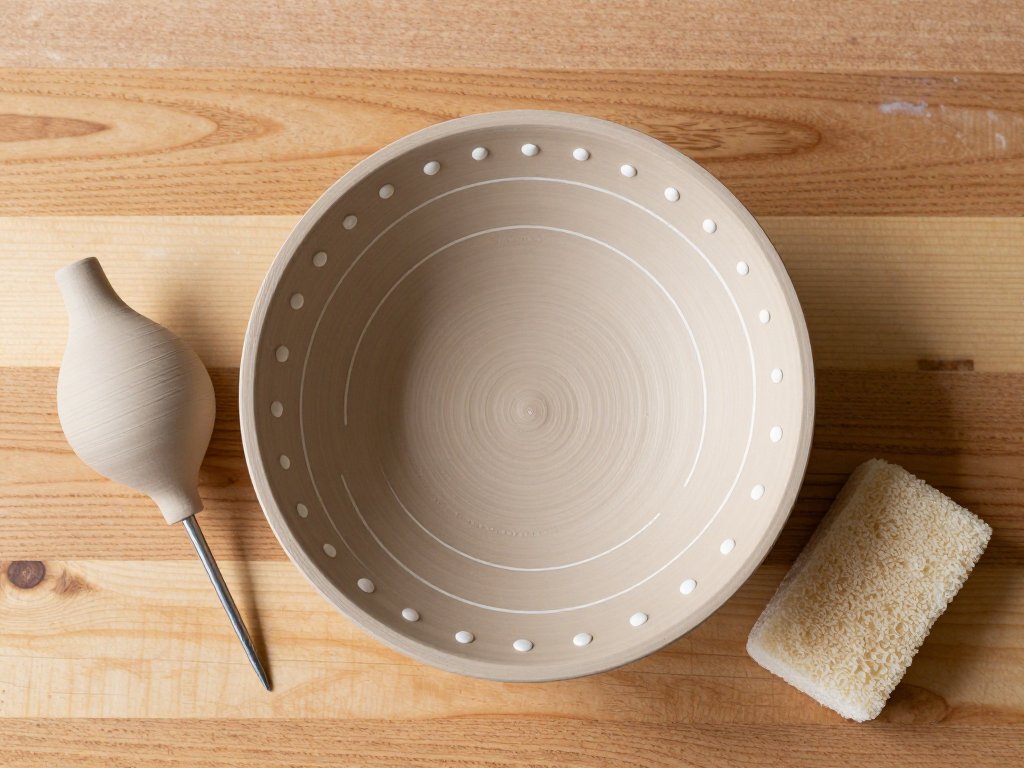
Sgraffito — an Italian term meaning "to scratch" — involves applying a layer of colored slip (liquid clay) to a leather-hard pot, then carving through it to reveal the contrasting clay body beneath.
The result is a crisp, graphic surface decoration that can range from delicate botanical illustrations to bold abstract geometry.
Sgraffito has become a signature technique for potters who want to combine sculptural form with two-dimensional drawing, and its popularity has grown alongside the broader revival of decorative carving in contemporary ceramics.
Wabi-sabi aesthetics continue to influence pottery deeply, perhaps more than any other single philosophical framework.
The Japanese concept of finding beauty in imperfection, impermanence, and incompleteness resonates powerfully with a generation that has grown tired of the relentless polish of digital imagery.
Wabi-sabi pottery celebrates the wobble in the wheel-thrown mug, the drip in the glaze, the crack in the firing.
Kintsugi — the art of repairing broken pottery with gold-laced lacquer — has moved from a niche practice to a widely admired metaphor for resilience and repair.
In 2026, a perfectly uniform, mass-produced ceramic object feels increasingly cold and soulless next to a slightly irregular, visibly handmade pot that carries the fingerprints of its maker.
Functional tableware — mugs, bowls, plates, serving dishes — remains the most popular category of contemporary pottery, and for good reason.
There is a quiet, daily intimacy to using a handmade mug for your morning coffee or serving dinner on a hand-thrown plate.
These objects bridge the gap between art and life, reminding us several times a day that we are surrounded by human hands, not just machines.
The functional pottery movement has been called "usable art," and its appeal in 2026 reflects a broader desire to infuse ordinary moments with meaning and beauty.
Clay as Community: Studios as the New Third Places
One of the most significant dimensions of pottery's resurgence is its social aspect. Sociologists have written extensively about the decline of "third places" — the informal gathering spaces, distinct from home and work, where community bonds are formed.
Cafés, pubs, barbershops, and community centers have been replaced, for many, by the isolating glow of personal screens.
But pottery studios are emerging as a new kind of third place for the twenty-first century.
Unlike a gym or a yoga class, where social interaction is often minimal, pottery studios foster a particular kind of low-pressure, side-by-side companionship.
People work on their own pieces at their own pace, but conversation flows easily across the room.
Questions about technique lead to discussions about glaze chemistry, which lead to conversations about life.
The studio becomes a social ecosystem where friendships form across lines of age, profession, and background that would rarely cross in other contexts.
"I've made more friends in the two years I've been doing pottery than in the five years before that," says James Okafor, a 28-year-old software developer in London.
"There's something about the studio that breaks down social barriers. You're all there because you want to be, not because you have to be.
When your hands are busy, you talk more honestly. There's less posturing."
Many studios have embraced this social dimension explicitly, hosting "BYOB" evening sessions, themed making nights, and community firings where everyone loads the kiln together and watches the results come out.
These events sell out weeks in advance. The pottery studio, it turns out, satisfies a need that no digital social network can touch: the need to be physically present with other people, creating something tangible together.
The Environmental Case for Handmade Clay
Pottery's boom also connects to a growing environmental consciousness. Mass-produced ceramics — the kind sold in big-box home goods stores — travel thousands of miles from industrial factories in China, Vietnam, or Portugal, packaged in plastic and foam, often destined for a landfill within a few years.
Handmade pottery, made locally, from locally sourced clay, carries a dramatically smaller environmental footprint.
Beyond the carbon argument, there is a deeper philosophical point. Objects made by hand tend to be kept longer, valued more, and discarded less.
When you know the person who made your coffee mug, or when you made it yourself, that mug acquires a significance that a factory-produced object cannot match.
It becomes a keeper, not a disposables. In a culture drowning in cheap, forgettable stuff, handmade pottery offers an alternative model of consumption: fewer objects, each one chosen with care.
Clay itself is one of the most abundant natural materials on Earth, and ceramic glazes — when formulated without toxic heavy metals — are chemically inert and environmentally benign.
Fired clay lasts for millennia, as the archaeological record attests. A well-made pot can serve a family for generations, be broken and mended with kintsugi, and eventually return to the earth as nothing more than crushed ceramic fragments.
It is a material life cycle of remarkable elegance.
Many contemporary potters are pushing this environmental ethic further, experimenting with foraged local clays, natural ash glazes, and wood-fired kilns that use reclaimed lumber.
The result is pottery that carries not just the fingerprint of the maker, but the signature of a specific place — a clay from a particular riverbank, an ash from a particular orchard.
This locavore approach to ceramics resonates with the same values that drive farm-to-table eating and slow fashion.
It is craft with conscience, made by people who care about where their materials come from and where their objects will end up.
Pottery as Side Hustle: From Hobby to Income
For many potters, the craft that began as a mindfulness practice has evolved into something more financially significant. The handmade ceramics market has grown substantially, driven by platforms like Etsy, Instagram Shops, and local farmers markets that connect makers directly with buyers.
The economics are worth understanding. A beginner on the wheel might produce three or four mugs in a full day, and after clay, glaze, kiln electricity, and studio fees, the margin is thinner than one might hope.
But as skills develop, efficiency improves. Experienced production potters can throw dozens of pieces in a session and command sixty to one hundred dollars for a hand-thrown dinner plate.
A meticulously crafted nerikomi vase can fetch several hundred.
What sells best? Functional ware — mugs, tumblers, plant pots, spoon rests, and serving dishes.
Decorative sculptural work sells more slowly but at higher price points. The key is not to approach pottery primarily as a business.
"If you start to make money, you'll quit," says Torres. "But if you start because you love clay, and you get good at it, the money finds you."
How to Start Today, with Nothing
Let's end where every journey should begin: with the first step. If this article has stirred something in you — a curiosity, a longing, a memory of making something with your hands — here is how to act on it today, with no equipment, no studio membership, and no prior experience.
Walk into any art supply store or order online: a two-pound block of air-dry clay. A basic wooden clay tool set — four or five tools with different tips for cutting, smoothing, and carving. A small sponge. A cup of water. That is all you need.
Take the clay and divide it into two pieces. With one piece, roll a smooth ball and press your thumb into the center.
Hold it in your palm and rotate it slowly, pinching the walls between thumb and fingers, letting the clay find its shape.
You are making a pinch pot — the same technique humans have used for over twenty thousand years.
Hollow a small bowl. Smooth the rim with a wet finger. Set it aside to dry.
With the remaining clay, roll a long, even coil — thick as your pinky finger.
Coil it into a spiral base, then stack more coils on top, pressing each one into the one below.
Blend the seams with your fingertip and water. You are coil-building a small vessel. Let it dry overnight.
In the morning, you will have two objects that did not exist the day before.
They will not be perfect. They will bear the marks of your hands — the slight asymmetry, the visible fingerprints, the small irregularities that make handmade things feel alive.
And you will have taken the first step into a practice that is transforming lives across the globe, one pinch, one coil, one centered pot at a time.
Conclusion: The Hands Remember
Pottery is booming in 2026 because it offers something the digital world cannot: a direct, unmediated encounter with physical reality.
It slows us down when everything else speeds us up. It asks for patience in an age of instant gratification.
It rewards presence when our attention is being harvested from every direction. And it reminds us, in the most fundamental way possible, that we are creatures with hands, who shape the world and are shaped by it in return.
The clay does not care about your follower count, your job title, your productivity metrics, or your carefully curated online persona.
It cares only about the pressure of your hands and the steadiness of your intention.
In that simple, demanding honesty, millions of people around the world are finding something rare and precious: a reason to put down their phones, to be fully present, to make something real.
That is why pottery is booming. That is why it matters. And that is why, if you have ever felt the quiet urge to create something with your own hands, there has never been a better time to begin.