Introduction
There is a moment every pottery beginner remembers: you pull a freshly bisque-fired piece from the kiln, and it is smooth, clean, and bone-white. It looks good, but it does not look finished. It needs that final touch — the glaze that transforms humble clay into something you would proudly display on a shelf or give as a gift.
Glazing can feel intimidating if you have never done it before. There are so many types of glazes — dipping, brushing, spraying — and the chemistry of how they melt and bond in the kiln can sound like a college course. But here is the truth: you do not need to understand every chemical reaction to get beautiful results. What you need is a gentle introduction to the basics, a few reliable techniques, and the confidence to experiment.
By the end of this article, you will know how to prepare your bisque-ware, choose the right glaze for your project, and apply it using two of the friendliest methods for a home potter. You will also learn the most common beginner mistakes so you can avoid them before they happen.
What Is Glaze, Really?
Glaze is essentially glass in liquid form — a suspension of finely ground silica, fluxes, and colorants in water. When you dip a pot into a bucket of glaze, the porous bisque absorbs water from the mixture, leaving a thin, even layer of dry glaze particles on the surface. When that coated piece goes into a kiln and reaches the right temperature (usually between cone 06 and cone 6, depending on the clay body), the particles melt and fuse into a durable, glassy coating.
That coating is not just decorative. It seals the porous clay body, making your pot food-safe and waterproof. It adds strength. And of course, it brings color, texture, and depth that raw clay can never achieve on its own.
For the home potter working in a small studio or even a garage, the most accessible glazing methods are dipping and brushing. Both give you excellent control and do not require expensive equipment. Let us look at what you will need to get started.
What You Will Need
Before you mix a single brushstroke, gather your materials. Preparation makes glazing go smoothly and prevents those last-minute scrambles that lead to mistakes.
Essential Supplies
- Bisque-fired pottery. Your pieces should be clean, dry, and free of dust. Wipe them with a damp sponge before glazing to remove any loose particles.
- Glaze. For beginners, start with commercial glazes from brands like Amaco, Mayco, or Duncan. They come ready-to-use in pint or quart jars. Choose three to five colors you love — you can mix them later once you are comfortable.
- Glaze brushes. Soft, wide brushes work best for even coverage. Look for hake brushes or bamboo glaze brushes. Avoid cheap craft brushes — they shed bristles into your glaze coat.
- Dipping tongs. A pair of metal tongs with rubber grips makes dipping safe and clean.
- Glaze bucket or wide container. For dipping, you need a container wider than your largest piece.
- Water bucket. For rinsing brushes and cleaning up.
- Sponge and needle tool. For cleaning up glaze drips and carving through glaze where it pooled too thickly.
- Stirring stick. Commercial glazes settle in the jar. Always stir them thoroughly before use.
- Kiln. You need access to a kiln that reaches the temperature recommended by your glaze manufacturer. Many community studios offer kiln services for a small fee.
- Kiln shelf. Wax resist or kiln wash to protect your kiln shelves from glaze drips.
Optional but Helpful
- Wax resist. A liquid wax you paint on the bottom of pieces to repel glaze. Prevents your pot from sticking to the kiln shelf.
- Spray bottle. For misting pieces to keep them damp during layered glazing.
- Notebook. Record what you used and how it turned out. Glaze journals are invaluable for reproducing successful results.
Preparing Your Bisque Ware
Bisque-fired pottery is porous — that is exactly what makes glazing work. But it can also be dusty, oily from your hands, or chipped at the foot. A little preparation goes a long way.
Start by inspecting each piece. Run your fingers over the surface. If you feel any sharp edges or rough spots, smooth them with a fine-grit sanding sponge. Pay special attention to the rim and the foot — these areas are often a bit rough after firing.
Next, wash your hands thoroughly and wipe each piece with a damp (not wet) sponge. This removes dust without saturating the bisque. Let the pieces air-dry for about thirty minutes. They should feel cool and slightly dry to the touch, not obviously wet.
If you are using wax resist — and we recommend you do — apply it now to the bottom quarter-inch of your piece. Dip a brush in wax resist and paint a clean ring around the foot. Let it dry completely before you glaze. The wax will repel the glaze, keeping the bottom of your pot bare so it does not stick to the kiln shelf.
The Dipping Method
Dipping is the fastest and most even way to apply glaze. It is also the most satisfying — there is something almost magical about watching a piece emerge from the bucket with a perfect, uniform coating.
How to Dip
Fill a bucket or wide container with enough glaze to fully submerge your piece. Stir the glaze thoroughly — you want an even suspension with no sediment at the bottom. The consistency should be about as thick as heavy cream. If it looks watery or drips off your stirring stick immediately, it is too thin. If it clumps and resists flowing, it is too thick.
Hold your piece with dipping tongs, gripping it firmly but without squeezing so hard that you crack the bisque. Lower it into the glaze at a slight angle to let air escape smoothly — submerging straight down can trap air bubbles against the surface.
Count three seconds, then lift the piece out in one steady motion. Let the excess glaze drip back into the bucket for a few seconds, then set the piece on a drying rack. If you applied wax resist to the foot, you can set the piece directly on a flat surface — the glaze should have stopped at the wax line.
One dip is usually enough for a solid, even coat. If you want a deeper color, let the first coat dry completely (about an hour), then dip a second time for the same duration. Double-dipping without drying can cause the wet glaze layer to slide off the pot in the kiln, so patience matters here.
When Dipping Works Best
Dipping is ideal for pieces with simple, smooth shapes — mugs, bowls, vases, and plates. It gives an even coat on both the interior and exterior in one motion. It is less practical for highly textured pieces or sculptures with deep crevices, where glaze can pool unevenly.
The Brushing Method
Brushing gives you more control than dipping and requires no special equipment beyond a good brush. It is the method of choice for detailed work, multi-color designs, and pieces with texture that you want to highlight.
How to Brush Glaze
Shake or stir your glaze jar thoroughly. Pour a small amount into a shallow dish or palette — about a quarter cup is enough to start. This keeps your main jar from getting contaminated with dust or dried glaze flecks.
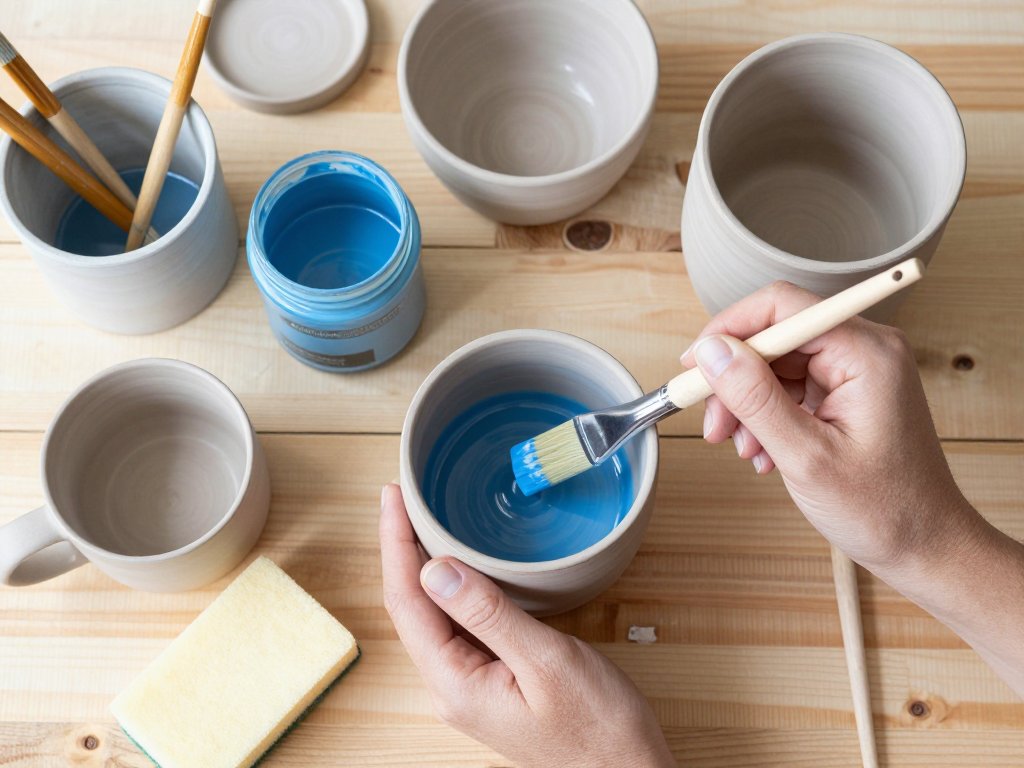
Dip your brush into the glaze and apply it in long, even strokes. Do not dab or pounce — that leaves an uneven coat. Work in one direction for consistency. Apply three even coats, letting each coat dry for about fifteen to twenty minutes before applying the next. Yes, three coats. One coat of brushed glaze is almost always patchy and thin. Three coats build up the thickness needed for a smooth, glossy finish.
For the most even results, alternate the direction of your strokes with each coat. First coat goes left to right. Second coat goes top to bottom. Third coat goes left to right again. This cross-hatching fills in any thin spots and prevents brush marks from showing in the final fired surface.
If your glaze is a bit thick, you can thin it with a few drops of water. Stir thoroughly and test a small area before committing to the whole piece.
When Brushing Works Best
Brushing shines on textured pieces — carved mugs, sgraffito designs, sculptural forms with grooves and ridges. It also lets you apply multiple colors to the same piece, something dipping cannot easily do. Want a mug that is deep blue on top and sandy tan on the bottom? Brush the top half with blue, let it dry, then brush the bottom half with tan.
Understanding Glaze Layering
Here is where the real artistry begins. Glaze colors interact with each other in the kiln in ways that can be surprising and beautiful. A base coat of one glaze under a coat of another can create speckles, crystals, cascading drips, or entirely new colors.
The key to successful layering is knowing which glazes play well together. Some commercial glaze lines are designed to be layered — Amaco Celadons over Potter's Choice glazes, for example, can produce stunning crystalline effects. Other combinations turn into a muddy brown mess.
Start by testing. Keep small test tiles of your clay body, bisque them, and paint a grid of glaze combinations. Fire them and record the results in your notebook. A single test tile session can save you from ruining a whole batch of pots.
Two dependable rules for layering:
- Light over dark. A light transparent glaze over a dark opaque glaze usually gives depth. Dark over light often overwhelms the lighter color.
- Thin over thick. If you apply one layer thick and a second layer thin on top, the second layer tends to melt into the first. If both are thick, the combined layer may run off the pot onto your kiln shelf.
And here is a comforting truth for the beginner: some of the most spectacular glaze results happen by accident. Serendipity is part of the ceramic process. Keep notes, but do not be afraid to try something that seems wrong. You might discover your new favorite combination.
Cleanup and Kiln Preparation
Once your pieces are glazed and fully dry, there are a few final steps before they go into the kiln.
Check the bottom of each piece. If any glaze crept past your wax resist onto the foot, scrape it off with a needle tool or sanding sponge. Glaze on the foot will melt and fuse your pot to the kiln shelf — a problem that ranges from annoying (prying it off with a chisel) to destructive (cracking the shelf or your piece). Take your time here.
Clean up any drips or uneven spots on the rim or handle with a damp sponge. Glaze tends to run in the kiln, and a thick drip on a rim can turn into a sharp edge or a puddle on the inside of the pot.
Wipe down your work surface. Rinse your brushes thoroughly and let them dry bristle-up in a jar. Glaze residue hardens like cement on brushes if left to dry. Seal your glaze jars tightly and label them with the date and any notes about consistency adjustments you made.
Glaze Firing Basics
You do not need to understand pyrometric cones in detail, but a few basics will help you get good results every time.
Your glaze manufacturer specifies a firing temperature, usually given as a cone number (cone 05, cone 5, cone 6). Fire to the cone they recommend. If you fire too low, the glaze will be dry and rough — a condition called underfiring. If you fire too high, the glaze will become runny and may drip off your piece — overfiring.
Most commercial mid-fire glazes are designed for cone 5 or cone 6. Low-fire glazes (cone 06 to cone 04) are common for decorative pieces. Always match your glaze to your clay body — earthenware clay cannot withstand stoneware firing temperatures.
Place your glazed pieces on the kiln shelf with at least a quarter-inch of clearance between each piece. They should not touch each other or the kiln walls. If you are stacking pieces inside each other (like nesting bowls), use kiln stilts or wadding to keep them separated.
Leave the kiln lid slightly cracked open for the first hour of firing to let moisture escape. Then close it fully for the rest of the firing. A slow cooling (letting the kiln cool naturally overnight) reduces crazing — those tiny hairline cracks in the glaze surface.
Common Beginner Mistakes and How to Avoid Them
Every potter makes these mistakes at some point. Knowing about them ahead of time will save you a lot of heartache.
Glaze Too Thick or Too Thin
The most common problem. If your glaze looks watery or chalky after drying, it is too thin — you need more coats or less water. If it looks like thick peanut butter and cracks as it dries, it is too thick — add water a teaspoon at a time until it flows smoothly.
Bubbles in the Glaze Layer
Small bubbles can form when glaze is applied over trapped air or moisture. To prevent them, ensure your bisque is completely dry before glazing and always submerge dipping pieces at an angle. If bubbles appear after drying, pop them with a needle tool and touch up the spot with a tiny brush.
Glaze Crawling
This looks like the glaze pulled away from the clay, leaving bare patches. It usually happens because the bisque was dusty or greasy, or because the glaze was applied too thickly. Good cleaning habits and consistent application thickness prevent it.
Pinholing
Tiny holes in the fired glaze surface. This is often caused by gases escaping from the clay body during firing. Slowing down the firing in the temperature range where gases release (around 1500°F to 1800°F for most clays) can help. So can applying a thinner glaze coat.
Sticking to the Kiln Shelf
Nearly always caused by glaze on the foot of the pot. Wax resist is your best defense. Check the foot carefully before firing and remove any glaze you find.
Finding Your Glaze Voice
As you gain experience, you will start to recognize your preferences. Maybe you love the deep, glossy look of layered celadons. Maybe you prefer matte finishes with subtle texture. Maybe you become the person who creates test tiles for everyone in your pottery group and shares your findings like a research paper.
Embrace the process. Every glaze firing teaches you something — even the ones that do not turn out as expected. A piece that comes out of the kiln looking nothing like you imagined is not a failure. It is data. Write down what you used, how you applied it, and what happened in the kiln. That information is gold for your next project.
And remember: some of the most beautiful pottery in the world was made by potters who started exactly where you are now — standing over a bucket of glaze, wondering if they mixed it well enough, hoping for the best. You will make beautiful things. Trust the process, keep your brushes clean, and never skip the wax resist.
Conclusion
Glazing your pottery at home does not require a degree in ceramics or a professional studio. With a few basic supplies, some patience, and the willingness to learn from each firing, you can create finished pieces that look like they came from a well-loved pottery studio.
Start with one simple method — dipping for smooth forms, brushing for textured ones. Use commercial glazes from trusted brands to remove the guesswork. Keep a notebook. Test combinations on small tiles before committing to a full piece. And most of all, give yourself permission to make pieces that do not turn out perfect. Every imperfect pot teaches you something the next perfect pot will benefit from.
Your journey from bisque to beautiful is just a dip or a brushstroke away. The kiln is waiting.