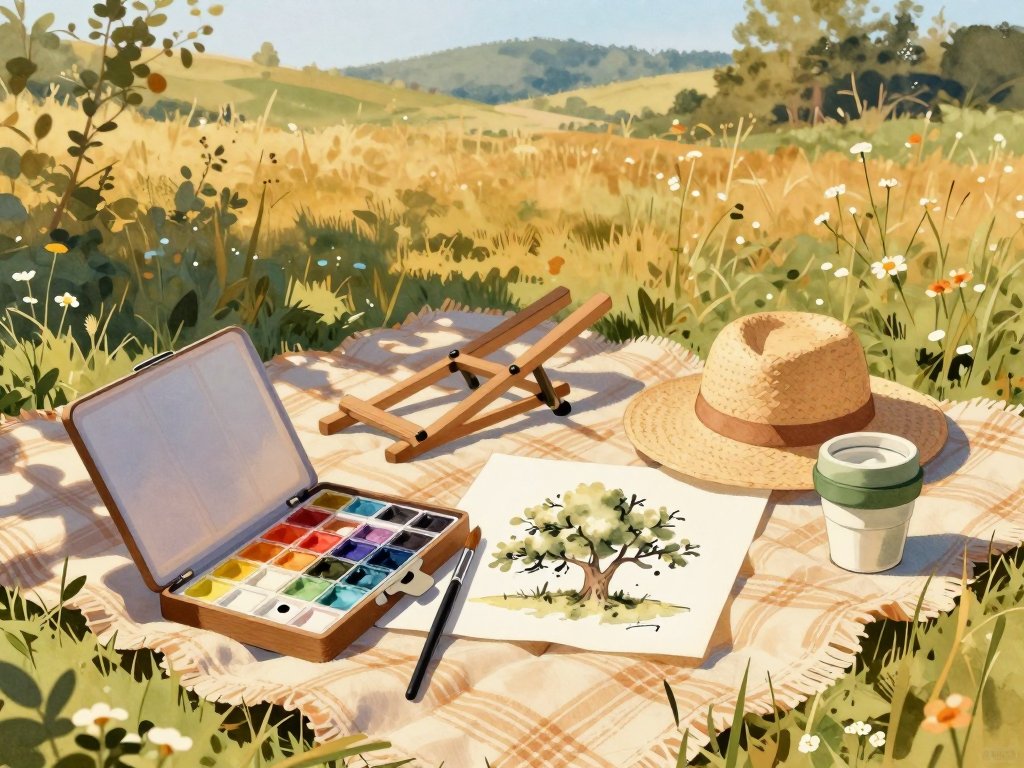
Introduction
I remember my first plein air watercolor outing like it was yesterday — mostly because I spent the entire afternoon apologizing to a very patient oak tree.
I had packed what I thought was a sensible tote bag with a few tubes of paint, a brush I'd found at the bottom of a drawer, and exactly one half-full water bottle.
By the time I'd hiked to the meadow I'd been dreaming about all week, I realized I'd forgotten a palette, a seat, and any way to carry water that didn't involve dribbling across two miles of trail.
I sat on the grass, looked at my meager supplies, and laughed. Then I painted anyway.
That afternoon taught me something I still carry into every outdoor painting session: a plein air kit isn't about having everything — it's about having the right things, and knowing why they matter.
As summer stretches out before us, with its long golden light and the irresistible pull of the outdoors, I want to share what I've learned to pack so that your time outside is spent painting, not rummaging or regretting.
Whether you're setting up by a creek in July or finding a patch of shade in your own backyard, the goal is the same: to capture a moment without being weighed down by your supplies. Let's walk through the kit together.
The Easel and the Seat: Your Foundation
Early on, I thought an easel was optional. I held my watercolor block on my lap, balanced my palette on a rock, and spent every few minutes shifting positions like a restless bird.
It wasn't until a fellow painter at a local workshop loaned me her field easel that I understood what I'd been missing.
A good field easel is lightweight, sets up in under a minute, and holds your paper at a gentle angle so water and pigment flow where you want them.
Look for one made of aluminum or carbon fiber — both hold up well in heat and humidity.
The field easels available at art tools sites come in various sizes, but for watercolor, a compact sketchbox easel or a lightweight tripod style is ideal.
You don't need a heavy studio easel; you need something that won't make you dread the walk to your spot.
And the seat? I cannot overstate how much a small foldable stool or a padded sit-upon changes the experience.
There are ultralight stools that weigh less than a water bottle and clip right onto your bag.
I use a three-legged camp stool that cost fifteen dollars and has survived three summers of abuse.
When you're not thinking about your aching knees, you're thinking about the light on the leaves.
That's the whole point.
Paints: Choose Freedom Over Abundance
There was a season where I packed eighteen half-pans into my kit because I was terrified of not having the right color.
I learned the hard way that a heavy palette is a joyless companion on a long walk.
Now I carry a compact palette of twelve colors — a warm and cool version of each primary, a few earth tones, and a single convenience green for when I'm feeling lazy.
Summer heat is worth considering when you choose your paint format. Tube paints can dry out in the heat or become overly soft, so many plein air painters prefer half-pans — small dried cakes of watercolor that reactivate with a spritz of water.
A good travel palette with a mixing area and a lid that doubles as extra mixing space is worth its weight in gold.
Fill it with your favorite brand before you head out, and you're set for weeks.
I also keep a tiny spray bottle in my kit. A quick mist over my pans before I start painting brings them to life instantly, and on a hot afternoon, it's a small comfort to feel that cool spray on my face too.
Paper and Blocks: The Surface You Trust
I once tried to paint on a flimsy sheet of student-grade paper during a breezy afternoon by the lake. The paper buckled, the wind caught the corners, and within ten minutes I was chasing a half-finished painting across a picnic blanket. Never again.
For outdoor watercolor, a block — a pad of paper glued on all four sides — is your best friend.
The glue keeps the paper from warping and eliminates the need for a drawing board or tape.
When you're done, you slide a palette knife into the slot at the top and pop the painting free, clean as a whistle.
Blocks come in various sizes; I find 9x12 inches to be the sweet spot — large enough to paint with freedom, small enough to fit in most bags.
Look for 100% cotton, cold-pressed paper at least 140 lb (300 gsm). It can handle multiple washes without falling apart, and it holds up to the unpredictability of outdoor conditions. Even if you get caught in a sudden drizzle, good paper won't let you down.
Brushes: Less Is More
I used to carry an entire roll of brushes, convinced I would need every possible shape and size.
Now I carry three. That's it. A round size 10 for washes and broad strokes, a round size 6 for detail and mid-size work, and a flat half-inch brush for crisp edges and bold passages.
Between those three, I can paint anything I see outdoors.
For travel, consider brushes with synthetic filaments that hold their shape and spring back after use.
Natural hair brushes are lovely, but they can be fussy in humid conditions and expensive to replace.
Synthetic brushes have come a long way, and many professionals use them exclusively. The key is to choose brushes with sturdy ferrules — the metal band that connects the bristles to the handle — because nothing ruins a painting session faster than a ferrule that wiggles loose.
I store my brushes in a simple canvas roll that I made myself one rainy afternoon, but any brush holder will do. The important thing is that the bristles aren't crushed or bent inside your bag.
Water: The Unseen Essential
You would think water would be the easiest thing to remember, given that we're painting with it.
Yet I have sat down by a beautiful stream, arranged my palette, adjusted my easel, and only then realized I had nothing to rinse my brush in.
I ended up cupping water in my hands, which works about as well as you'd imagine.
Now I carry two collapsible silicone cups — one for clean water, one for rinsing.
They fold flat when empty and weigh almost nothing. Some painters use a single large jar with a screw-top lid, but I prefer the two-cup system because I can keep one source of clean water for mixing and the other for washing pigment off my brush.
On a long afternoon, clean water becomes a precious resource.
If you're painting near a natural water source, you can refill your rinse cup as needed — just be mindful of what you're putting back into the environment.
Never rinse paints directly into lakes or streams. Use your dirty water cup, and dump it away from the water's edge when you're done.
The Palette: More Than a Mixing Surface
A good palette is the unsung hero of a plein air kit. I've used everything from a porcelain dinner plate (heavy, breakable) to a repurposed egg carton (surprisingly functional, but flimsy).
What I've settled on is a folding metal or plastic palette with deep wells that keep my paint from drying out too fast in the summer sun.
A palette with a lid is a game-changer. When the wind picks up or a curious dog bounds over, you can close it and keep your carefully arranged colors intact.
Many travel palettes also feature a thumb hole, which lets you hold the palette in one hand while painting with the other — incredibly useful when you're standing or working in a tight spot.
Before you head out, take a moment to arrange your colors in a consistent order on your palette.
I always put my yellows on the left, reds in the middle, and blues on the right, with earth tones below.
Your muscle memory will thank you when you're chasing the last light of a summer sunset.
The Sketchbook: Your First Draft of the World
Not every plein air outing needs to result in a finished painting. Some of my most cherished outdoor art sessions have happened in a small sketchbook, with just a pencil, a travel brush, and a tiny folding palette.
A sketchbook is where you make friends with a scene before you commit to a full sheet of paper.
I keep a 5x7 inch sketchbook in my bag at all times. It's small enough to pull out during a lunch break or while waiting for a friend, and large enough to capture a composition, jot down color notes, or test a wash.
Some pages become finished little paintings; others remain loose experiments that teach me something about how light falls or how a shadow behaves at a certain hour.
For summer plein air, a sketchbook is also your best tool when conditions aren't perfect. Too windy for a full painting? Sketch. Too hot to sit still? Do quick gesture drawings of the people walking by. The sketchbook keeps you in the practice even when circumstances conspire against a masterpiece.
Sun Protection: Pack It or Regret It
This is not the glamorous part of the kit, but I promise it matters more than any specific brand of paint.
I have spent many July afternoons with my shoulders turning the color of a ripe tomato because I was too absorbed in my painting to notice the sun creeping across the sky.
A wide-brimmed hat is non-negotiable. It shades your eyes, your face, and the back of your neck.
A lightweight, long-sleeved shirt made of breathable fabric will keep you cooler than short sleeves because it reflects the sun instead of absorbing it.
Sunscreen on every exposed patch of skin — including the tops of your hands, which I always forget until they're pink and painful.
Consider a small umbrella that clips to your easel. Not only does it keep you shaded, but it also shields your paper from direct sunlight, which can dry your washes before you've had a chance to blend them.
There are specialty painting umbrellas out there, but a simple photography reflector works just as well.
And bring water to drink, not just to paint with. Dehydration creeps up quietly when you're focused, and a headache in the middle of a painting is no way to spend an afternoon.
The Bag: Carry It All With Comfort
I've gone through more bags than I care to admit. A canvas tote. A backpack from high school. A messenger bag that left my shoulder aching for days. What I've learned is that the best bag for plein air is one that distributes weight evenly and keeps your hands free.
A cross-body bag or a small backpack works beautifully. Look for one with multiple compartments so your paints aren't rattling against your water cup and your paper block has a dedicated slot.
Many artists swear by a fishing vest with deep pockets — a tip I picked up from an older painter who said, "A vest keeps everything close and never tips over." I haven't gone that far yet, but I respect the logic.
Whatever you choose, test it before your first real outing. Fill it with your kit, take a walk around the block, and notice what annoys you.
Does the strap slip off your shoulder? Is the zipper hard to reach? Does everything shift to one side?
Fix those problems at home, not in a field with the light fading.
Putting It All Together: A Sample Kit
If you're new to plein air and feeling overwhelmed by the choices, here is a simple, budget-friendly kit that will serve you well all summer long:
- Easel: A lightweight aluminum tripod easel or a sketchbox easel
- Seat: A foldable camp stool or a waterproof sit-upon pad
- Paints: 12 half-pans in a compact travel palette with a lid
- Paper: A 9x12 inch 140 lb cold-pressed watercolor block
- Brushes: Round size 10, round size 6, flat half-inch — three brushes total
- Water: Two collapsible silicone cups
- Spray bottle: Small, for reactivating paints and cooling off
- Sketchbook: 5x7 inch, for studies and notes
- Sun protection: Wide-brimmed hat, sunscreen, long-sleeved shirt, drinking water
- Bag: Cross-body bag or small backpack with compartments
You can assemble this kit for well under a hundred dollars if you shop wisely, and the pieces will last for years.
The watercolor supplies available online make it easy to compare prices and read reviews before you commit.
Start simple, and let your kit grow with your practice.
Reflections for the Road
Before you head out the door with your freshly packed kit, take a moment to ask yourself a few questions. They're not meant to stress you out — they're meant to help you notice what you actually need.
What time of day are you painting? Morning light is cool and blue-tinged; afternoon light is warm and golden.
Your paint choices might shift depending on the hour. How far are you walking? A quarter-mile stroll lets you carry more than a two-mile hike.
Let your legs decide what goes in the bag. What kind of scene are you after?
A wide landscape calls for bigger washes; a close-up of flowers or a tree trunk lets you work small and detailed.
Let the subject guide your brush selection.
Most importantly, ask yourself: what do I want to remember about this day? Because that's what plein air painting really is — not a perfect rendering, but a record of being present in a particular place at a particular moment, with the light exactly as it was, and the breeze exactly as it felt.
Conclusion: The Kit That Lets You Forget Itself
That first plein air afternoon, the one where I sat on the grass with a too-thin brush and a too-small water bottle, I painted a small study of the oak tree that had been silently watching my struggle.
It was not a good painting. The proportions were off, the washes were muddy, and there was a suspicious brown smudge in the corner that I still can't explain.
But when I look at it now, years later, I don't see the mistakes. I see the way the light filtered through those leaves at four o'clock in July.
I feel the warmth on my arms. I remember the sound of a red-winged blackbird from somewhere across the field.
The best plein air kit is the one you forget you're carrying — the one that dissolves into the background so all that's left is you, your paper, and the world in front of you.
As you pack your bag for your next summer outing, choose each item with care, but don't let the choosing become more important than the going.
Bring what you need, leave what you don't, and trust that whatever you paint will be enough.
Because the oak tree isn't keeping score. And neither should you.