Introduction
A few years ago, my daughter came home from school with a tiny sketch of her best friend on a sticky note. The nose was crooked, the eyes were different sizes, and the hair looked more like a haystack than anything human. But when I looked at it, I recognized that friend instantly. There was something true about the drawing — something that captured personality far better than a technically perfect portrait could.
That sticky note taught me something important about drawing faces. It is not about precision. It is about observation, practice, and the willingness to draw a hundred imperfect faces so that the hundred-and-first one starts to feel like someone you know.
That is exactly what this challenge is: sketch one hundred faces in seven days. Not one hundred perfect faces. One hundred honest attempts. By the end of the week, you will not just be better at drawing faces — you will see faces differently. You will notice the curve of a jawline, the way light falls on a cheekbone, the tiny asymmetry that makes every face unique. And you will have built a habit that will stay with you long after the challenge ends.
Why One Hundred Faces?
The number one hundred is not arbitrary. It comes from the concept of deliberate practice — the idea that doing something repeatedly with focused attention leads to measurable improvement far faster than sporadic, unfocused practice.
Drawing one hundred faces in seven days means you will draw roughly fourteen to fifteen faces each day. That is not a huge number — fifteen quick sketches can take as little as thirty minutes. But over seven days, the cumulative effect is remarkable. Your hand learns the proportions of the face. Your eye learns to measure relationships between features without thinking. The fear of the blank page fades because you are filling pages so quickly that you do not have time to be afraid.
There is also something magical about the sheer volume. Around face thirty or forty, something shifts. You stop worrying about making the drawing look good and start simply enjoying the act of drawing. The process becomes the point. And that is when the real learning happens.
What You Will Need
The beauty of this challenge is that it requires almost nothing. You do not need special paper, expensive pencils, or a studio. You just need a few basics.
Supplies
- A sketchbook. Any sketchbook will do. A pocket-sized one (about 5 by 7 inches) is perfect because you can carry it everywhere. Look for one with paper that handles light pencil work well — nothing too textured or too smooth.
- A drawing tool you love. A mechanical pencil (0.5mm or 0.7mm) is ideal for quick sketches because you never need to sharpen it. A regular No. 2 pencil works fine too. If you feel adventurous, try a ballpoint pen — it forces you to commit to every line and has a lovely, expressive quality.
- A reference source. This could be a magazine, a photo album on your phone, a website like Pinterest or Unsplash, or the people around you. The best reference is real life — a sleeping partner on the couch, a child reading, a stranger on the bus.
- A timer. Your phone timer is perfect. You will be working with time limits.
That is it. No eraser required (seriously — for this challenge, do not erase. Just draw the next face.)
The Rules of the Challenge
Simple rules keep the challenge focused and fun. Here is how it works.
- Draw fifteen faces each day for seven days. That totals one hundred and five, but one hundred is the minimum. The extra five are for days when you are on a roll.
- Spend no more than three minutes per sketch. Speed is the point. If you spend thirty minutes on one face, you defeat the purpose. Set a timer and stop when it rings.
- Do not erase. You are not aiming for perfection. Every wobbly line and mismatched eye is data that teaches your brain what to adjust next time.
- Draw from life whenever possible. Photos are fine, but drawing a real person — even a stranger in a coffee shop — trains your eye in ways photos cannot.
- Date every page. When you look back at day one compared to day seven, you will be amazed at the progress.
Day One: Warm-Up and Breakdown
Start with the basics. Before you draw a full face, spend your first five faces breaking the face down into simple shapes.
Draw an oval for the head. Add a horizontal line halfway down for the eyes. Add a vertical line down the center. The eyes go on that horizontal line, spaced about one eye-width apart. The nose goes halfway between the eyes and the chin. The mouth goes halfway between the nose and the chin. The ears align with the eyes and the nose.
These are called the standard proportions, and they are your foundation. Most faces follow these proportions roughly, though everyone is slightly different. Your job is to learn the standard so well that you can then see and capture the exceptions that make each face unique.
Draw five faces using only these basic proportion lines. Keep them loose. They are not portraits — they are maps.
Days Two and Three: Eyes, Noses, and Mouths
Now focus on individual features. Spend these two days drawing eyes, noses, and mouths separately.
Eyes
The eye is not a football shape. It is more almond-shaped, with the outer corner slightly higher than the inner corner in most people. The iris is partially covered by the upper eyelid — drawing the full circle of the iris makes the eye look startled. The highlight on the eye (the catchlight) is what makes it look alive. Always leave a tiny white spot.
Draw five eyes. Then five pairs of eyes. Three minutes each, two minutes each, one minute each. Speed up as you go.
Noses
The nose is mostly shadow and highlight. Do not draw the outline — it looks like a cardboard cutout. Instead, draw the shadow under the nose, the shadow at the sides, and the highlight on the bridge. Let the paper provide the highlights. This is the single best tip for drawing noses: suggest them with shadows rather than drawing them with lines.
Draw five noses from different angles — front, three-quarter, profile. Notice how the shadow patterns change with each angle.
Mouths
The mouth is defined by the line where the lips meet — the lip line. Draw that line carefully. The upper lip is usually darker and more defined than the lower lip. The lower lip has a subtle highlight. Do not draw every tooth — suggest them with a horizontal line or let the viewer imagine them.
Draw five mouths. Then five with the jawline included. Try smiling, closed, and neutral expressions.
Days Four and Five: Full Face Sketches
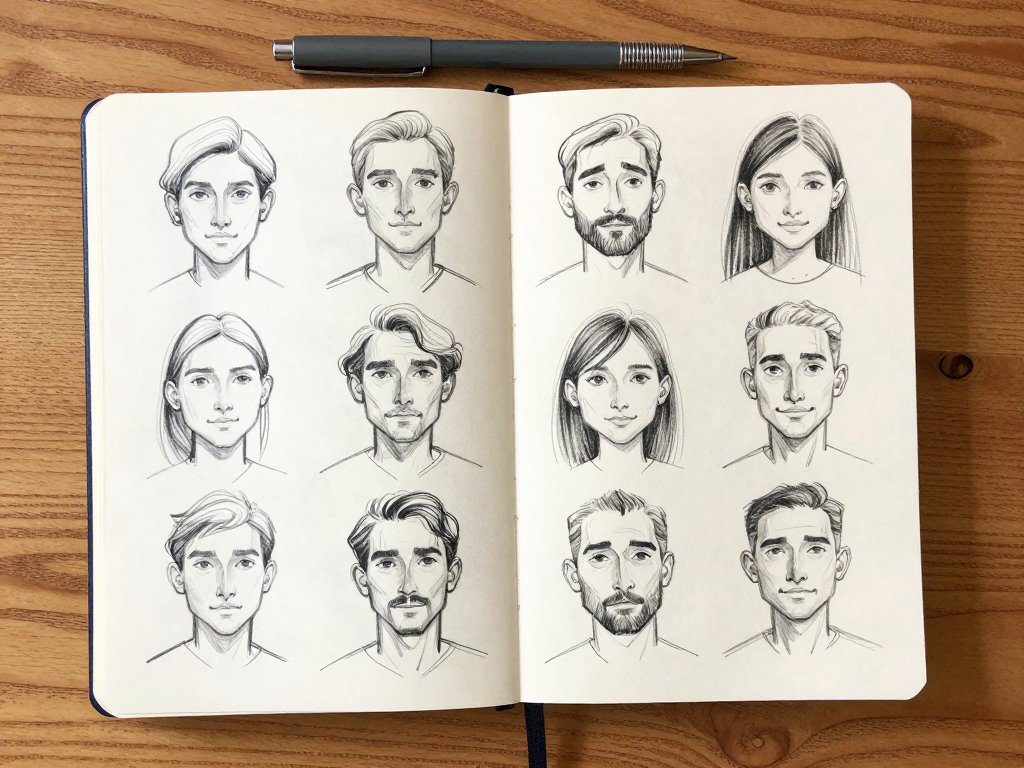
Now put it all together. Draw full faces using your reference of choice. Start with front-facing portraits, then move to three-quarter views, then profiles.
Keep the timer at three minutes. The goal is not a finished portrait — it is a quick capture of the essential character of the face. What makes this person look like themselves? Is it the angle of their eyebrows? The curve of their jaw? The distance between their nose and upper lip?
If a sketch goes wrong, that is fine. Draw the next one immediately. The worst thing you can do is linger on a bad sketch. The best thing you can do is turn the page and start again.
Each day, look at your sketches from the previous day and pick one thing you want to improve. Maybe your eyes are consistently too high. Maybe your noses are too dark. Focus on that one thing for the next ten faces.
Days Six and Seven: Speed Rounds and Expression
These are your final push. Increase the speed and challenge yourself with expressions and angles.
Try thirty-second sketches. Set your timer for thirty seconds and draw a complete face before it rings. You will not draw a good face in thirty seconds. But you will train your brain to see the most important features first — the ones that define the face. That instinct is invaluable.
Then try one-minute sketches of faces with strong emotions: laughing, frowning, surprised. Expressions change the shape of the entire face. The eyebrows lift, the mouth widens, the cheeks bunch up. Capturing expression is about capturing the relationship between features, not the features themselves.
By the end of day seven, you will have filled twenty or more pages of your sketchbook with faces at every angle, in every expression, at every level of success and failure. And you will have something more valuable than any single drawing: the confidence to keep going.
What to Do When You Get Stuck
Even with the best intentions, you will hit walls during this challenge. Here is how to push through.
"I ran out of faces to draw"
Look around you. Your family, your pets, the barista who made your coffee, the person sitting across from you on the train. If you are at home alone, use a mirror — draw yourself from different angles. Or open a magazine and draw the faces in the ads. There are faces everywhere.
"My drawings are getting worse, not better"
This is normal. Around day three or four, many people feel like their sketches are regressing. What is actually happening is that your eye is improving faster than your hand. You are seeing mistakes you did not notice before. That is real progress. Keep drawing. Your hand will catch up.
"I do not have time for fifteen faces today"
Do five. Or three. Or one. The challenge is a guideline, not a test. Any face you draw is better than none. If you miss a day entirely, just add five extra to the remaining days. The only rule that matters is that you keep drawing.
"I hate every drawing I make"
Good. That means you care. But here is a reframe: the drawings you are making today are not for showing anyone. They are for the artist you will be in a month, a year, a decade. That future artist will look back at these sketches with affection — not because they are technically good, but because they are the record of a week when you showed up and practiced. That counts for more than any polished piece.
After the Challenge
Once you have completed your one hundred faces, give yourself a day to rest. Then look through your sketchbook. Notice the progression. The early faces are stiff and careful. The middle ones are looser. The late ones — even if they are not technically better — have a confidence that the early ones lack. That confidence is the real prize.
Now what? You can repeat the challenge with a different subject — one hundred hands, one hundred trees, one hundred pet portraits. Or you can take a single face from your last day and spend thirty minutes on it, applying everything you learned. Or you can simply keep drawing at your own pace, knowing that you have built a habit that will serve you for the rest of your creative life.
The sticky note my daughter drew all those years ago is still taped to my desk. It is not a good drawing by any technical measure. But it is a drawing someone cared enough to make, and that makes it good in the only way that matters.
Your one hundred faces matter the same way. Not because they are perfect. Because you drew them.
Conclusion
Drawing one hundred faces in a week is less about art and more about showing up. It is about giving yourself permission to draw badly, to fill pages with imperfect sketches, and to discover that the only way to get better at drawing faces is to draw a lot of faces.
The skills you build — quick observation, confident line work, the ability to capture character in moments — will transfer to every other kind of drawing you do. A hand that has sketched one hundred faces can sketch anything.
So grab a pencil. Open to a blank page. Set your timer for three minutes. And draw a face. Then draw another. Before you know it, you will have drawn more faces than you ever thought possible. And you will look at your sketchbook and smile — not because every drawing is good, but because every drawing is yours.