Introduction
What if you made a drawing and never once looked at the paper until it was finished?
Not a sketch. Not a study. A drawing made entirely by feel, with your eyes fixed on the object in front of you and your pencil moving on trust.
That is blind contour drawing, and it may be the strangest and most useful ten minutes you spend at a kitchen table this week. Your first one will look wrong. The mug will lean. A finger will wander toward the edge of the page and simply stay there.
You will finish it and feel a small, specific embarrassment.
Then something quieter happens. You look at your own hand — the actual hand, not your idea of a hand — and you notice the shape of the knuckle at the base of your thumb for what may be the first time.
This is not a party trick. It is the oldest warm-up in drawing, and it works because it goes after the real problem, which was never your hand.
What Blind Contour Drawing Actually Asks of You
In a blind contour drawing, your eyes stay on the subject for the entire drawing. Your pencil stays on the paper, moving in one unbroken line. You do not look down until the timer stops.
That is the whole exercise. One rule holds it together: the pencil records what your eyes are doing, not what your brain remembers.
Your hand is not drawing a mug. Your hand is drawing the path your eye takes as it travels the rim of a mug.
If your eye stops at the handle, the line stops at the handle. If your eye wanders off the edge of the form, the line wanders off too.
Nothing gets corrected. Nothing gets measured. There is no eraser in this exercise, and there is no version of it where you get the proportions right by checking.
This is different from copying a shape from memory. When you draw from memory, you draw a set of ideas about the object. When you draw blind, you draw the object itself, one edge at a time, at whatever pace your eye can honestly hold.
A Short History: Nicolaides and the First Week of Art School
The exercise comes to us from Kimon Nicolaides, a drawing teacher at the Art Students League in New York. His book, The Natural Way to Draw, was published in 1941, three years after his death, and it is still in print.
Nicolaides built the book as a course of study organized into daily schedules. Contour drawing sits near the very beginning, before shading, before composition, before anything that could be judged as finished work.
His reasoning was blunt. Students, he wrote, look at objects and see only a label. They draw the label. The contour exercise forces the eye to stay with the actual edge long enough for the label to fall away.
Almost a century later, foundation courses still assign it in the first week. Not because it is traditional, but because it is diagnostic. A teacher can watch ten minutes of blind contour and know exactly how a student is looking.
Why It Works: Edges Versus Symbols
Your brain is an efficient machine that would rather recognize than observe. Show it a face and it hands you "face." Show it a chair and it hands you "chair," assembled from a stored idea of four legs and a back.
That efficiency is useful for walking through a room and terrible for drawing. The stored idea is generic. The actual chair in your kitchen has a back rail that dips, a leg that sits at a slightly different angle, a shadow line where the seat meets the frame.
Blind contour interrupts the shortcut. With your eyes off the paper, you cannot compare your drawing to your idea of the object. You can only follow the edge in front of you.
This is also a hand-eye coordination drill, and a patient one. Your hand learns to move at the speed of your looking instead of the speed of your guessing. Those are very different speeds, and most beginners have never felt the slower one.
Accuracy is not the goal. Seeing is the goal. The drawing is just the receipt.
What You Need (Almost Nothing)
You do not need a sketchbook for this. Any paper works — printer paper, the back of an envelope, a page from a notebook, the inside of a cereal box.
You need something to draw with. A pencil is traditional, and a softer pencil like a 2B feels lovely because it glides and leaves a confident dark line. A ballpoint pen works just as well, and it has one advantage: you cannot erase, so the temptation disappears.
You need a timer. Your phone is fine, set to two minutes and placed face down and out of reach. A kitchen timer is even better, because you cannot check it for messages.
You need a subject with clear edges. A mug. A shoe. A pair of scissors. A houseplant with broad leaves. Something that holds still and has a definite outline.
That is the complete list. No eraser, no ruler, no blending stump, no special lighting, no expensive paper. If you have a pen and a receipt, you can do this exercise right now.
The Rules, Stated Plainly
Six rules. They are short, and every one of them matters.
- Eyes on the subject the entire time. From the first mark to the last, your gaze stays on the object.
- One unbroken line. The pencil touches the paper once and does not lift until you are done.
- No peeking. Not a glance, not a quick check, not "just to see where I am."
- No erasing. There is nothing to erase, because there is no wrong line. Every line is a record of where your eye went.
- No judging. You are not allowed to have an opinion about the drawing until the timer stops.
- Set a timer. Two minutes for your first attempt. The timer decides when you are finished, not your patience.
The "no judging" rule is the one people break first, and silently. You will feel the criticism rising about forty seconds in. Let it pass and keep your eyes on the object.
Your First Two Minutes: Your Own Hand
Your own non-drawing hand is the perfect first subject. It is always available, it never moves unless you move it, and you have looked at it ten thousand times without ever really seeing it.
Rest the hand on the table, palm down or lightly curled, whichever is comfortable to hold for two minutes. A hand propped against a mug is easier than one held in the air, because a raised hand begins to tremble.
Choose a starting point on the edge — the side of a fingernail, the outer curve of the pinky, the ridge where the thumb meets the wrist. Put your pencil down there and begin.
Move your eye slowly along the edge. Not the whole hand at once. One edge. Follow it to a corner, a crease, a change of direction, then follow the next edge it leads to.
Your hand should move at the same pace as your eye. This is the part that feels unnatural, because your hand wants to rush ahead and finish the shape it already knows.
When you lose your place — and you will, usually around the knuckles — do not look down. Stop the pencil where it is. Retrace the last stretch of edge in your mind until you find the point you last trusted, then continue from there.
Two minutes of this feels longer than two minutes of almost anything else. That is normal. When the timer goes, look at the paper.
The Ten-Minute Version: A Shoe, a Plant, a Chair
Once two minutes feels survivable, move to a more complex subject and give it ten. A shoe with laces. A houseplant with leaves that overlap. A kitchen chair with spindles and a curved back rail.
Complexity is the point. A mug has one outline. A chair has dozens of edges, and each one forces a decision about which edge your eye follows next.
Ten minutes changes the exercise in a specific way: you run out of the obvious edges.
The rim, the handle, the base — those are consumed in the first two minutes.
Then you are left with the small stuff. The seam where the handle meets the body.
The slight irregularity of a hand-thrown rim. The shadow line under a leaf.
This is where slowing down pays off. Most people find that the second half of a ten-minute contour is more accurate and more interesting than the first, because the eye has finally stopped skimming.
Set the timer for ten and resist the urge to check it. If you finish early, you were drawing too fast. Sit with the subject a little longer and find one more edge.
What a Wobbly Drawing Is Telling You
Your blind contour will look like a deflated balloon. Lines will double back. The thumb will be the size of the forearm. A finger will float, unattached, near the corner of the page.
Here is why, and here is why none of it is a failure.
The wobble is a literal record of your eye's path. Eyes do not move in smooth curves. They jump, pause, and correct in small increments called saccades. On paper, that shows up as a line that hesitates and restarts.
The drift in proportion happens because you are tracking edges in sequence rather than comparing widths. You are not measuring the thumb against the palm. You are following one edge until it ends, then the next. Sequential drawing distorts scale, always.
The floating finger happens because your eye moved to it before your pencil finished the previous edge. That's not a mistake either. That's the exercise working exactly as designed.
A tidy blind contour is usually evidence of peeking, or of drawing from memory between glances. A messy one is evidence that you actually looked.
Common Mistakes (and How to Catch Yourself)
Peeking. The most common, and the most innocent-feeling. Your eyes slide down "just to place the next line." Notice it, put your gaze back on the subject, and keep going.
Drawing from memory between glances. This one is subtle. Your eyes stay on the object, but your hand draws the generic idea of a hand. The tell is a line that looks confident and wrong. Slow your eye down until the hand has to wait for it.
Going too fast. Fast hands produce tidy, invented drawings. If your pencil reaches the end of an edge before your eye does, you are drawing ahead of yourself.
Tightening your grip. A death grip on the pencil makes short, scratchy, tense lines. Hold the pencil further back, almost like a brush, and let your whole arm move.
Choosing a subject with no clear edges. A sponge, a fluffy cat, a glass of water — all legitimate drawing subjects, all terrible for this exercise. Start with something with a defined outline and soft, empty background.
Judging the result. If you look at your drawing and think "that's bad," you have missed the point by a wide margin. The drawing is not the product. The looking is.
A One-Week Practice Plan
Five to ten minutes a day, one subject each day. That is the entire plan, and it fits into the gap between the school run and dinner.
- Day one: your own hand, two minutes. The classic starting point.
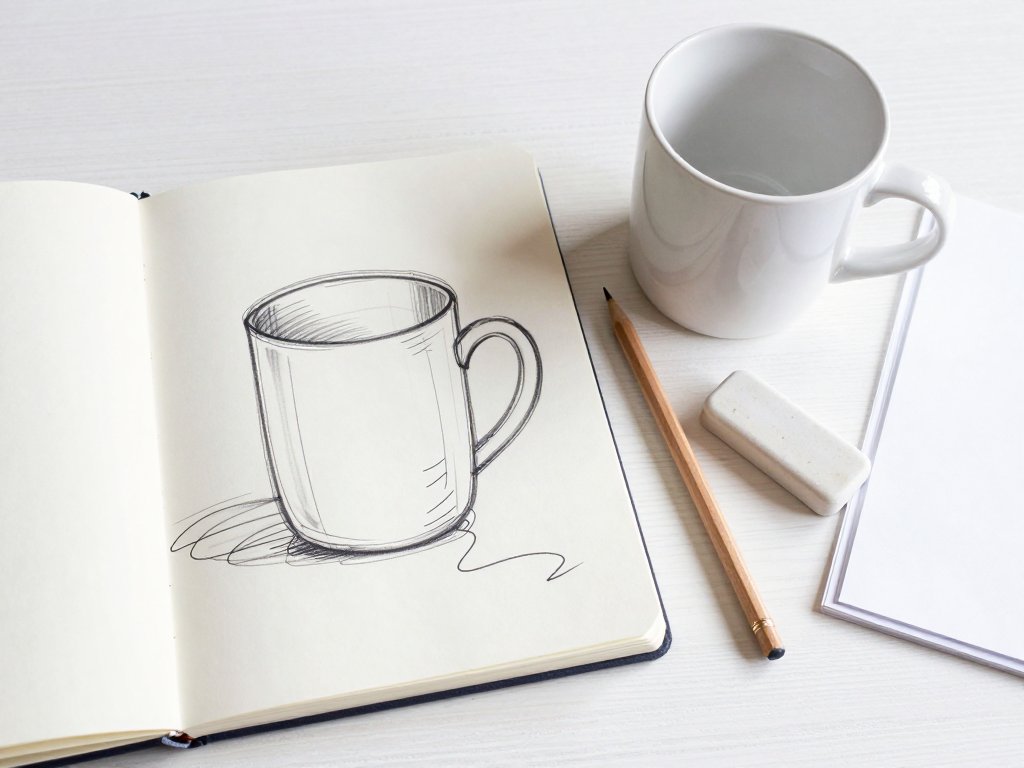
- Day two: a mug, three minutes. One outline, one handle, no excuses.
- Day three: a shoe, five minutes. Laces are a gift — they force your eye to change direction constantly.
- Day four: a houseplant, seven minutes. Overlapping leaves teach you to decide which edge comes first.
- Day five: a kitchen chair, ten minutes. Spindles, rails, and a curved back.
- Day six: a pair of scissors, ten minutes. Negative shapes between the handles are surprisingly hard.
- Day seven: anything in the room you have never drawn. Choose it in ten seconds and start.
By day five, something specific shifts. Your eye moves in smaller increments. You stop jumping from one feature to another and start travelling the edges between them.
You will also catch yourself in the middle of knowing what comes next — and stop. That pause is the whole skill. It is about the looking, not the line.
The Modified Contour: When to Let Yourself Glance
After a week or so, most people are ready for the modified version. The rules stay the same except one: you may look at your paper roughly ten percent of the time.
Ten percent of a ten-minute drawing is about one minute, which is four or five quick glances. Use them to check placement, not to correct the drawing. Glance, register where you are, return your eyes to the subject.
The point of a modified contour is to bring the seeing habit into drawings you actually want to keep. You are not abandoning the blind exercise. You are carrying its attention into a drawing that has to fit on the page.
When to move on: when blind contours stop feeling like an emergency, and when you can feel your eye slowing down on its own. If your blind drawings are still a scramble, stay with them another week. There is no prize for graduating early.
When you want a cousin of this exercise, continuous line drawing keeps the pen down while letting you look.
Doing It With Children
Children take to this instantly, and the reason is simple: they have not yet learned to be embarrassed by a bad drawing.
Frame it as a game with a rule, not a lesson. "Draw the mug without looking at your paper, like you're a spy." Then do it alongside them, and let yours be visibly terrible.
A five-year-old will produce a tangle and then tell you, with total confidence, exactly what it is. That is the correct response. Ask what they noticed about the handle, not what they think of the drawing.
Resist correcting. Resist saying "that's really good" in the tone that means "that's surprisingly good." Say something true instead: "You found the little bump on the rim. I missed that."
Keep sessions to two minutes for young children, five for older ones, and let them pick the subject. A toy with a clear silhouette works better than a person who wriggles.
If a child says "mine looks bad," the answer is straightforward: it is supposed to. Everyone's does. That's how you know you didn't peek.
Troubleshooting: Losing Your Place and Other Small Emergencies
You lost your place. Stop the pencil. Do not look down. Retrace the last few inches of edge in your mind until you reach a point you trust, then continue.
If you truly cannot recover, place the pencil at a new edge and start a fresh line — the drawing will have a gap, and that gap is honest.
Your hand is cramping. You are gripping too hard. Loosen your fingers, hold the pencil further from the tip, and use a larger sheet so your wrist is not curled into a tight space.
You ran out of page. Very common, because we draw larger through the interesting parts. Start smaller and nearer a corner, and accept that some drawings will run off the edge. A line that exits the page is a fine drawing.
Your subject moved. Blame the subject, not yourself. Choose still things while you are learning. If you must draw a person, draw one who is asleep, or hold your own hand firmly against the table.
You feel silly. Close the door, or do it with someone else and compare the wreckage afterward. The feeling passes in about ninety seconds, and it is usually replaced by mild fascination.
What This Actually Trains
Blind contour drawing does not train your hand. Your hand already knows how to hold a pencil. What it trains is attention — the ability to stay with one thing, at one speed, for longer than is comfortable.
That is a rare skill in a day full of interruptions, and it is the same skill every other kind of drawing depends on. Shading, proportion, perspective — all of them are downstream of looking carefully at what is actually there.
So keep the drawings. Put them in a drawer, or on the fridge if you are brave. In a month, the pile will show you something the individual drawings cannot: your eye getting slower, more patient, more willing to stay.
The lines will still wobble. That was never the point.
Ten minutes, one pen, one mug on the table, and your eyes somewhere other than the paper. That is the whole practice, and it is waiting whenever you have a quiet moment.